Because I Care ~ MEDITATION WITHOUT
THE CENTER
BEFORE RUSHING
INTO ANYTHING, it is advisable to do some research;
this applies to spiritual matters no less than to
material concerns, for if we rush into things, we
might go wrong for a long time, suffering as a result,
and regretting it later on. Some time given to the
investigation of things would probably be well-spent.
We seem to have a propensity to grasp onto
things, thereby becoming stuck. Perhaps it is the
fragility and insecurity of life that compels us to
hold onto things as a means of support and defense,
much like the proverbial drowning man clutching at
straws. We hold onto ideas, concepts and beliefs more
firmly than to material things; for example, we can
go through life holding the same beliefs, little changed,
but might move house several times, have many cars,
selling one and buying another, and even get divorced
a few times, like some movie-stars. We crave psychological
more than material security, but this is not surprising,
as security is really a state of mind, and if we do
not feel secure mentally, no amount of material possessions
can compensate for it. If we feel insecure, we grope
around looking for someone or something to support
us; we worry, doubt, and ask people if they really
do love us— parents, children, husbands, wives,
friends— and become tedious thereby. To feel
insecure is quite horrible, and leads to many other
negative and undesirable states of mind. How is it
possible to be happy if we feel insecure?
The last few years have seen an upsurge
of interest in meditation; meditation has become popular,
as if it’s something new that we’ve never
known before. Many of us plunge into practicing meditation
without much understanding or preparation, and often
either out of greed to attain something we’ve
heard may be attained, or from fear of not attaining
it and thus remaining as we are— the prospects
of which are not very appealing— or of even
slipping back. Unaware that meditation, in a sense,
is something ordinary that we’ve been doing—
or that has been going on in our minds— ever
since we began to think, we dive headlong into all
kinds of practices which we have been told, and so
believe, will lead us to Enlightenment. Eagerly we
begin, but lacking a firm foundation in ourselves,
many soon grow discouraged when we get no quick results,
and easily quit. Others continue, convinced that the
path we are on is the right one, merely because it
is our path. Because we so desperately want to attain
something, it often happens that we bring about a
self-projected end, and see just what we want to see,
ignoring everything else. Some of us are so impatient
for results that we can think of nothing else, and
either become fanatics about it or/and ‘blow
a fuse’ and short-circuit, becoming mentally
deranged. Many get stuck on what we consider to be
the correct posture for meditation, and insist that
it be done in the lotus position, with right hand
on left hand, thumb-tip lightly touching thumb-tip,
eyes down-cast and half-closed, fixed on a point just
in front, etc. Somewhat naughtily, perhaps, I like
to ask: "If a person has lost his legs, and cannot
sit in the lotus-posture as a result, does it mean
he cannot meditate?" The mind is not in the legs,
is it?
Now, I’m not implying we shouldn’t
sit in meditation in this manner, and that it is all
a waste of time, for it does have its benefits, as
long as we are careful how we go about it, and know
why we wish to do this particular thing. We must be
careful not to defeat our own aim, which we would
if we set about meditation with the idea of becoming
enlightened or gaining insight thereby, for meditation
like this has a center— the self, or the one
who is meditating— and whatever has a center
will also have a circumference, even if it is a million
miles away. And so, starting off with self at the
center, we will ultimately meet self again at the
circumference, and lo! will be back where we began,
and still in Samsara.
Though it is useful as a disciplinary exercise
of the mind, it will not lead to enlightenment if
we are looking for it, for when we look for something,
we do so with an image or idea in mind of what we
are looking for. This is fine if we already know what
we are looking for, because then we will recognize
it if/when we come across it. But since we have not
yet any knowledge or experience of enlightenment—
full enlightenment, anyway, if there is such a thing—
how shall we begin to look for and recognize it? This
is the problem that the practice of meditation gives
rise to.
But there is a kind of meditation that has
no center and therefore no circumference, that is
not practiced or done, but which, rather, comes to
us, or creeps up on us when we are not looking for
or expecting it. It is hard to say if there are any
conditions for its arising— and better not to
say, as people would try to create those conditions
in the hope that the meditation would automatically
follow as a result, and thus, once again, it would
be a manufactured thing with a center. It seems to
come when we are at ease with our surroundings, at
peace with the world, not worrying about anything,
not looking for anything, when the mind is calm and
clear, when we are sensitive, open and receptive,
when joy is near the surface.
But, though I have named some of the factors
that appear to be present when this meditative state
arises, I must stress that it cannot be produced,
that it is not within our capacity to ‘make
it happen,’ and in that sense, we— that
is, the ‘I’ in us— cannot become
enlightened. "Why not?" you might ask; "Then
what is the point of following the Dharma?" You
see? Just look at the nature of this question: clearly,
it reveals the desire to get something out, without
which there would be considerable doubt and hesitation
about following the Way. "If I’m not going
to get anything out, then why should I bother to live
by the Dharma? I may as well live without restraint,
having a good time and enjoying myself!" Clearly,
those who think like this— and it is not rare—
are wrongly motivated. Why follow Dharma? Because
it is the natural thing to do once we have seen how
life is; it is not a matter of getting something out,
but of putting something in.
Why do I say we cannot become enlightened?
Simply because enlightenment has no room for self;
the idea of ‘self,’ as opposed to ‘others,’
must dissolve and disappear for enlightenment to arise,
or, to put it another way: enlightenment burns out
and destroys the concept of self. Whichever way we
look at it, selfishness and enlightenment cannot co-exist
in the same mind; one of them must dominate, and we
all know which one usually does. Krishnamurti once
put it this way: "To talk of so-and-so ‘attaining
liberation’ is a misuse of terms. That which
is liberated is always life, not the individual. Indeed,
it is at the expense of the individual that such liberation
is achieved."
Many of us go about meditation in a materialistic
way: wishing to attain something, to get something
out. It would be better, before we begin anything,
to examine our motives for doing it; it might save
us a lot of time and trouble.
Meditation is really a way of learning about
life— life as it is, and not how we wish it
to be. This requires we look with dispassionate minds,
just to see what is here, instead of imposing our
values and opinions on things, and saying things like
‘This is good/bad,’ ‘This is nice/not
nice,’ ‘I like/ dislike this/that,’
etc. A good exercise is to look closely at something
that one was formerly afraid of— if anything—
such as a snake or spider, for example, and observe
it doing what it does. The more carefully one observes
it, the more closely one will feel with it, and in
so doing, might realize that the fear of it has quietly
ebbed away, replaced with a feeling of rapport, of
atonement— ‘at-one-ment’—
with it; one has entered into the spirit of the thing
observed, and the fear of it that was formerly there
has gone.
As we grow older, we tend to lose our spirit
of inquiry, and become weighed down by the cares and
concerns of the world; our vitality dries up, and
we become like old bamboo, stiff and dry, and set
in our ways. Yet is this inevitable? Must it be so?
Have we no control at all over it?
It is vital to maintain our interest in
life, and our research into it, so that our inquiries
sink down into the subconscious, or deeper part of
the mind, and go on there, even during sleep. Meditation
is not just something that takes place when we sit
in a special posture, but is something that can go
on anywhere, at any time. It is a matter of learning
about life, of seeing it as it really is, instead
of wishing it would conform to our desires. We are
all parts of life, fragments of the whole; we belong
to life, rather than it belongs to us. If life were
really ours, we could say, with all certainty, "I’m
not going to grow old, get sick, or die." But
the fact that we do grow old (if we are lucky), get
sick, and die, shows that life is not ours, as a possession;
on the contrary: we are Life’s! To recognize
and accept this puts us in a different position: we
will no longer pit ourselves against life, but will
accept the way things are and align ourselves more
closely with reality; our efforts will thereafter
not be spent in struggling against the inevitable,
but in working in co-operation with what cannot be
changed. Needless to say, this requires wisdom, and
not just a complacent acceptance of things. We must
have wisdom to know what can and what cannot be changed.
Meditation yields insight into the realities of life.
When we are very interested in something
it is easy for the mind to stay focussed, whereas
if we are not interested, the mind easily strays.
This is the key we need: interest. Most of us are
only superficially interested— if at all—
in finding out what is true; because of this, we jump
around like grasshoppers, from one teacher to another,
from this method to that, and get very little for
our efforts; we look outside of ourselves, and expect
others to provide answers for us, to tell us what
to do— in other words: to think for us. But
how can this be?
Below is a picture of the Buddha preaching
His first sermon to the five ascetics or yogis in
the Deer Park at Sarnath, near Benares in northern
India; it is a very illustrative picture, and much
might be learned from it.
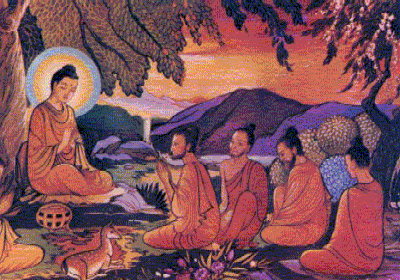
The yogis are not all sitting in the same meditation
posture, like statues, but are relaxed— relaxed, but
at the same time, attentive. They would not have been
thinking of the past, of the future, or even of the
present; nor would they have been thinking of or practicing
meditation. They would have been in the present, would
have been in meditation, and the meditation they were
in would have no center and no circumference. I feel
quite confident that most people have, at times, experienced
this kind of unproduced meditation, even if they did
not recognize it as such. As the Buddha spoke about
the Four Noble Truths, one of the yogis— Kondanya, by
name— understood, and the Buddha could see it, not just
with His mental powers but with His normal vision, because
when someone understands deeply and clearly, it shows
on his face (I have seen it once, and it is a most remarkable
and unforgettable sight, like a light shining outwards).
He said: "Kondanya has understood! Kondanya has understood!"
During the following days, the other yogis also became
enlightened through listening to the Buddha speak. If
we, by reason or effort, cannot reach Enlightenment,
it is within our capacity to develop interest in life,
in Dharma, to become more sensitive and receptive, to
open the doors of our hearts and minds, to be watchful
and alert. It is possible. Reality is all around and
within us, never absent for a moment.
|