Because I Care ~ TAKING A STAND
SOME TIME AGO, I PICKED
up a Buddhist magazine, on the cover of which was
a design purporting to show the hand of the Buddha
turning the Dharma-wheel. On the back cover, however,
there was a commercial advertising, among other things,
meat and fish for sale. Strange companions, front
and back!
Certainly, I am aware that money must be
raised for the publishing of such magazines; it doesn’t
grow on trees. But I also think that discretion should
be used in the selection of advertisements to be included
in Buddhist magazines, even if it means rejecting
some and thereby losing some funds; after all, the
purpose of publishing such magazines is to propagate
the Dharma, is it not? If we compromise our principles,
we defeat our purpose. By allowing the pages of a
Buddhist magazine to be used for advertising meat
for sale, we are—even if only indirectly—condoning
killing.
Feel free to disagree; it won’t prevent
me speaking out. Some Buddhists maintain that the
Buddha never said we should be vegetarians, and that
monks (who the bulk of the Buddhist rules apply to),
may eat whatever is offered to them, as long as they
do not see, hear, or suspect that the animals, fish
or fowl were killed especially for them; if they so
see, hear or suspect, they are forbidden to eat the
flesh. But this standpoint is totally indefensible,
as anyone who looks at things a little objectively
can see. And to say, as some people do, that by eating
meat, they are helping the animals with their spiritual
growth, is too ridiculous and transparent to be seriously
considered for a moment.
Firstly, the Buddha never called anyone
to believe or follow Him; instead, He urged people
to see for themselves and find out what is true. Even
so, many Buddhists become prisoners of books, repeating
things like parrots or tape-recorders, without investigating,
thereby missing the great value of the Buddha’s
Way, which is a Way of self-reliance. He exhorted
people to "Test my Teachings as a gold-smith
would test gold," and "Work out your own
salvation with diligence" (according to the Buddhist
scriptures, these were His last words), and not depend
upon Him to save them, because "Buddhas are only
Teachers; they do but point the Way"—which
is the most that anyone can do; belief in saviors
is regarded as a myth, with no foundation in fact.
To use scripture to justify the disgusting
and cruel habit of eating meat is both dishonest and
unworthy. I’ve never been able to reconcile
the preaching of Metta-Karuna (Loving-Kindness &
Compassion) with the practice of meat-eating; they
contradict each other. And as to seeing, hearing or
suspecting that the animal was killed especially for
someone, well, for whom is the animal killed if not
for those who eat its flesh? No amount of twisting,
juggling and verbal gymnastics can get around that.
If nobody ate meat, the butcher would not kill the
animals. This is not only obvious to everyone except
those who refuse to see, but is in line with the Buddha’s
teachings about the Law of Dependent Origination,
or Cause-and-Effect in the moral realm, where-by it
is shown how one thing leads to another in a chain-like
sequence. Let us examine the eating of meat by this
doctrine, and see what it involves:
THE CONSUMER. The consumer likes to eat meat,
and his desire to do so is the main force that keeps
this Killing Wheel turning.
THE KILLER. Because of people’s habit
of eating meat, others see a way of earning a living
and take up the gun and knife to engage in butchery.
There will always be butchers and war and senseless
destruction of life, as long as people condone killing;
it is a matter of demand-and-supply: if there is a
market for meat, some will try to supply it—just
as with drugs, sex and weapons.
THE ANIMALS. The animals are victims of the
unwholesome desire for flesh. Though it may be the
karma of the animals to be killed—as some believe—that
does not excuse the killer. The cause produces the
effect, and the effect, in turn, becomes the cause
of other effects, and so on.
THE BUYER. The butcher kills for money. If
nobody ate meat, the butcher would have to find another
job. Those who buy and eat meat keep the butcher’s
hands bloody, and the only people to whom this is
not clear are those who do not want to see.
It is like the trade in ivory and rhinoceros-horn:
because of the demand for these things, elephants
and rhinos have been hunted and killed to the point
where they are now in danger of extinction. Ivory
is prized for its beauty and rhino-horn for what is
believed to be its aphrodisiacal-properties, which
is probably just another silly and cruel superstition.
In order to boost their libido, or sexual energy—so
they believe—people are prepared to let these
magnificent animals be shot and left to rot on the
African veldt. The poachers who kill them cannot be
totally blamed for this, as they are just one link
in the chain, and not the main link, either. Most
of them are just poor tribesmen who also need to live,
and the possibility of making big money far outweighs
the risk of getting caught and prosecuted. No, the
buyers and users of the animal products are the real
cause of this, and there is no getting away from the
fact. Stop the demand, and the supply will cease.
What a pity people are so selfish and stupid—much
moreso than the animals on which they look down with
scorn!
Someone once told me of a high-ranking Tibetan
lama appearing surprised to learn she was vegetarian,
and asked her why. And, far from praising and encouraging
her for abstaining from meat, he even disapproved
of it (maybe because, being carnivorous himself—and
greatly attached to the taste of meat—he took
it as a criticism of his habit).
Some years ago, in Malaysia, I was invited
to stay in someone’s home, where I was served
nice vegetarian food. One day, I went into the kitchen
to get some water, but my way was barred by the son
of the house; his mother was there eating her lunch.
She knew I knew she was not vegetarian, but was embarrassed
that I should see her eating meat. However, it was
her house, not mine; I was only the guest there. If
she wanted to eat meat, she should have done so without
being ashamed; the fact that she was ashamed was a
sign she had reservations about it.
If a person wants to eat meat, let him at
least be honest about it and admit he likes it, and
not use the scriptures to justify it, as that is cowardly
and unscrupulous. Let him also be prepared to accept
the consequences of his involvement in killing, without
complaining or blaming others for whatever happens
to him, for he is surely involved.
Because of Tibet’s altitude, few vegetables
will grow there and so the diet of the people is largely
and unavoidably animal-based. The majority of Tibetans
are Buddhists and very pious as such. They scrupulously
avoid killing anything—even to the extent of
beating firewood vigorously on the ground to shake
free any insects before burning it. How, then, do
they get the meat they eat? The butchers of Tibet
are Muslims, who are regarded by the Buddhists as
‘low caste’ or ‘defiled’ because
of their livelihood. The Buddhists obviously do not
see the discrepancy in their outlook on this, which
smells strongly of hypocrisy.
"If you delight in killing, you cannot
fulfil yourself," wrote Lao Tsu in the Tao Te
Ching. Are these just empty words? How shall one attain
Enlightenment except by opening one’s heart
and becoming sensitive to the rights and feelings
of others? We do not live by and for ourselves alone.
What kind of Enlightenment is it if we are indifferent
to the pain and suffering of others? Enlightenment
is not just something to be hopefully attained as
a result of following the Dharma, but should be something
that manifests in our lives as we go about our daily
living.
Now, suppose one person here—perhaps
you—and another one there, starts to think about
this, and reflects thus: "If no-one ate meat
or wore furs or skins, the animals would not be killed
for such. I do not agree with killing, for the animals
have the right to live and do not want to die—just
like me. I can live quite well on vegetables, and
so, as a protest against killing and as an expression
of sympathy for the animals, I will become vegetarian
from now on." Let us further imagine what would
happen if the 300,000-plus monks in Thailand—where
Buddhism, for the most part, has become passive and
moribund—decided to stop eating meat, and asked
the lay-people to offer them only vegetarian food:
Every day, millions of animals—cows, pigs, goats,
chickens, ducks, fish, prawns, etc.—would not
be needlessly slaughtered; many lay-people would also
probably become vegetarians. But I am happy to report
that now, at last, there is a new movement in Thailand
which is making quite an impression. The monks of
this movement are strict vegetarians, which is something
I never expected to see there, but am certainly very
happy about. They lead simple lives, free from the
modern paraphernalia that fills many of the monasteries
these days, and wander around preaching. So there
is hope; it all depends upon understanding, and begins
with people like you and I.
Many people mistakenly think that, alone,
they can do nothing to change the world, and that
whatever they might do will make no difference. This
is weak-minded, shortsighted and wrong and, because
so many people have been touched by the Story of the
Stranded Starfish in one of my previous books, I will
not ask pardon for repeating it here, so that it might
touch others.
Early one morning, a man went to the beach,
and, while strolling along there, he noticed, some
distance ahead of him, a young boy frequently bending
down to pick things up and throw them into the sea.
At first, he thought it must be stones the boy was
throwing, but as he got nearer to him, he realized
it was starfish. When he caught up with the boy, he
asked him why he was doing this, and the boy replied
that the tide was ebbing and the starfish were stranded
on the beach, unable to get back into the water, and
would die of exposure as the sun rose higher in the
sky and became hotter. The man looked at the starfish
all over the beach, and said: "But there are
millions of starfish on this beach; how can your efforts
make any difference?" The boy looked at the starfish
he was holding, then looked up at the man and said:
"It will make a difference to this one!"
and flung it back into the sea.
Can you put yourself into the place of that
starfish? It is most important, on a spiritual path,
to be able to identify and empathize with others,
including animals.
We cannot force anyone else to change, but
we can change ourselves, and thereby change the world,
as we are part of the world, and if we change, the
world also changes, be it ever so little. Don’t
always wait for others to make the first move, therefore;
if you are convinced a thing is right, follow it;
no matter if it seems that you are all alone, you
should know that you are never really alone.
Are you concerned about suffering? If so,
you should know that it is not something personal,
like your private property, but something common and
world-wide. If you do not like to suffer, do something.
Don’t just call yourself a ‘Buddhist,’
and wait for someone to help you; do something yourself!
Calling oneself ‘Buddhist’—or any
other name for that matter (this is meant not just
for Buddhists)—has very little meaning. But
to be aware that we can do something to make our world
a little bit better, instead of worse, and to do it,
that is something! "Morality," as philosopher
George Santayana said, "is the desire to lessen
suffering in the world." Now, what do you think:
Does eating meat increase or decrease the suffering
in the world?
People become vegetarians for different
reasons, but to abstain from eating meat because one
thinks it is better for health or for ‘making
merit,’ or from the consideration that a chicken
or fish might have been one’s relative or friend
in a previous lifetime, are not Buddhist reasons for
being vegetarian. A Buddhist abstains from eating
meat because he knows it is right to abstain, and
not from what he might get, personally, from doing
so. He is a vegetarian for the sake of the animals,
not for his own sake; he considers the effects of
his actions upon others.
Forget about what the Buddha may or may
not have said about eating meat; He died a long time
ago, and none of us ever met Him. We are not the slaves
of the Buddha—or are we?—but have minds
of our own, which He exhorted us to use. The animals
are being killed right now, often with our tacit consent
and approval. What do you think about this? While
it means food for many, money for others and sport
for some, for the animals themselves it means suffering
and death. Surely, this deserves some thought. We
should not be so subjective, always looking at things
from our own viewpoint, wondering how we can make
use of things for our own ends. The viewpoint we should
look at meat-eating from is that of the animals, is
it not? Try to put yourself in their position, and
see how it feels.
Now, reading this, some people—monks
and non-monks —will probably fall back on the
old worn-out argument: "But Buddhist monks are
not allowed to ask for anything special for themselves,
saying, ‘I like this’ or ‘I don’t
like that.’ They are supposed to eat whatever
people are kind enough to offer to them, without making
a fuss and causing inconvenience to their supporters."
Yes, it is good for monks to refrain from being fussy
and choosy, but if they were to request people to
offer them only meatless food, they would not be asking
for themselves, but for the sake of the animals; their
asking would be altruistic instead of selfish. And
it would benefit the people who offer as well as the
animals, for their offerings would involve less suffering
and so would be more meritorious. From every point-of-view,
therefore—including health and economy—
vegetarianism is better. And, as for the lame excuse
that, without eating meat, we would not get enough
nourishment and would be weak and sickly, well, what
about elephants, horses, cows, buffaloes, etc.? They
are herbivorous, and are not weak! It is our minds
that are weak, not our bodies! So, why hesitate? Is
it because of attachment to taste? Is it because we
might find it inconvenient to change our diet? Do
we live to eat, or eat to live? In order for us to
eat meat, the animals must be killed. Is that not
a great inconvenience for them?
Ah, attachment! Some people may counter
what I have said above by saying we can be attached
to vegetarianism, too, and that attachment is attachment
in any form, and ends in suffering; we can be bound
just as firmly with gold chains as iron chains, and
should follow the Middle Way that avoids extremes.
But is this so? Isn’t it a matter of who and
how? Following the Middle Way doesn’t mean living
in a non-committal, wishy-washy manner, without principles
or firm foundations; nor does it mean following a
set of rules imposed upon us or adopted from outside.
Following the Middle Way means living according to
our understanding, and trying to keep Dharma at the
center as a focal point, not self; we can still be
flexible while holding fast to the essence and not
compromising one’s principles; it must come
from inside— from realization of how things
are— not outside. The Middle Way— or Noble
Eightfold Path— on paper, is a general guideline,
and must be seen as such; the Way is not in the books,
but in walking it, not a concept or doctrine, but
a living thing of experience. And some of the Buddha’s
final words were: "Be an island unto yourself;
be a lamp unto yourself; be a refuge unto yourself.
With the Dharma as your refuge, look not outside of
yourself for a refuge." He did not mean cling
to it as a personal possession and become attached
to it, considering it a thing of self, but to abide
by it, live by it, accord with it, for in so doing,
we may break free of the idea of self. And the basic
Five Precepts— covering our relationships with
other living things (not just people)— are designed
to help us refrain from causing suffering.
To understand ourselves— which is
what the Dharma is all about— we must see ourselves
in context, for alone and in isolation, there is no
meaning; we simply do not exist like that. If we follow
the Way from fearful self-concern, far from getting
what we hope to get, we only cause ourselves more
suffering. To become vegetarian with the idea of getting
something in return, such as ‘merit,’
or better health, demonstrates the kind of attachment
that causes suffering; but to do it with the idea
of lessening the suffering of others, means abiding
in Dharma; we cannot call this attachment.
It is often difficult to talk about vegetarianism
to non-vegetarians, for there is always the implication
of criticism or disapproval of their meat-eating—indeed,
just being vegetarian, without saying a word, is to
make a statement —and few of us can accept criticism
gracefully, even when it is constructive, as in talk
about vegetarianism. But if we refrain from saying
what needs to be said because we think people may
not like it and therefore might not support us, truth
will be fettered and gagged. Is this why there is
so little Dharma-propagation in many of the big and
rich temples in Asia, where, more often than not,
ceremonies and superstition hold center-place, and
crowd out all else?
We must sometimes choose between speaking
the truth and being popular, as the truth is often
unpopular. Maybe this is why Lao Tsu said: "The
wise person hears of the Tao [Way, or Dharma], and
follows it carefully. The average person hears of
the Tao, and thinks about it now and then. The foolish
person hears of the Tao, and laughs aloud. If there
were no laughter, the Tao would not be what it is."
Thus, the laughter of fools, who are unable—
or refuse— to comprehend, is a tribute to Tao.
The praise of fools is something more to be concerned
about than their laughter, while the criticism and
censure of the wise should be taken to heart.
If we wish to propagate Dharma, there is
an element of risk involved; we must face the possibility
of being unpopular, as we cannot please everyone,
and if we try, we might end up pleasing no-one. We
may dilute the Dharma to suit the tastes of those
who are unable or unwilling to accept it as it is,
but what would happen to the quality? There would
hardly be any flavor left!
Many Westerners, new to Buddhism, spontaneously
become vegetarians as a result when they hear the
teachings about Compassion and Respect for Life. What
a pity, therefore, that many allow themselves to be
influenced and persuaded into dropping their gentler
mode of eating when they come into contact with forms
of Buddhism that do not espouse vegetarianism, instead
of persisting in it. It’s a pity they lack the
courage of their convictions, and conform, for the
sake of convenience or so as not to be different.
Should we not find out for ourselves what
is right and wrong, true and false? In this world
of confusion, where it is hard to resist the pressure
to conform, if we know a thing to be right, should
we not try to abide by it? Not to do so would be to
lose the precious little integrity we might have and
which we must try to increase. Why should we follow
others, like sheep? Is it because we think others
always know where they are going, while we do not?
Using the Dharma and seeing things as they are, we
have a way to develop clearer vision and more self-confidence
than this.
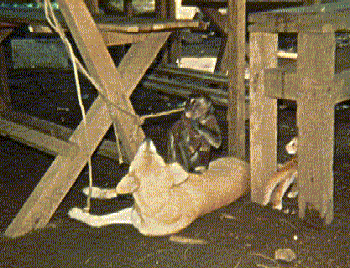
To conclude: Just as it is natural for a flower
to give off scent, so Vegetarianism should be a natural
expression of our understanding that, just as we ourselves
wish to be happy and avoid pain, other living things
feel exactly the same way. Is it really so esoteric
that only very few people are able to comprehend this?
I don’t think so, and therefore I’ll continue
to stand up for the animals, and say:
STOP
THE KILLING!
BE
KIND TO ANIMALS—BY NOT EATING THEM!
|