Because I Care ~ BATAAN REVISITED
THE SKY WAS OVERCAST
as we left Manila— my two companions and I—
on the morning of December 19th 1999 for what used
to be the Bataan Refugee Camp— otherwise called
PRPC or Philippines Refugee Processing Center (an
odd name that always made me think of a food-canning
factory; no wonder many refugees felt they were merely
commodities or statistics on paper, without real identities!)
They had offered to drive me out, and I had gratefully
accepted. Being a Sunday, the traffic wasn’t
so heavy, and it didn’t take us as long to escape
from the vortex of the city as it would have done
on other days; Manila is so congested that it is choking
on its own emissions. It took us 3½ hours to
get there, as parts of the road was still in bad shape
from the damage caused by the cataclysmic eruption
of Mt. Pinatubo in 1991.
When we arrived at the check-point, we were
held up for some minutes while the guards checked
with their superiors at the Administration Building.
Satisfied we had a legitimate reason for visiting
the Camp, we were finally allowed in "to visit
the temples only"; we got the impression that
there must be some secret activities going on there,
though what they might have been, we didn’t
discover and could only guess at.
Proceeding from the check-point, it was
as if I had never been there before, as there were
no refugee billets in sight, like there used to be,
but only thick overgrowth, and many trees where I
remembered none. I was somewhat confused, and gave
the driver halting directions. We turned into a familiar
road that led to the temple in Neighborhood Seven,
but it was only with some difficulty that we were
able to discern the temple-gateway through the tangled
vegetation; in just a few short years, the jungle
had taken over again completely.
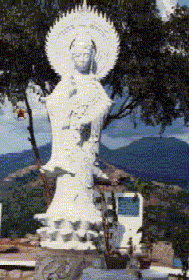
Forcing a passage through the gateway, we
could then see the Kwan Yin (Quan Am) image behind
a clump of bamboo I had planted during my last visit
in ’87; it had not been vandalized, but remained
as it was when the Camp closed in ’94, its hand
raised in perpetually blessing. A marble plaque stood
beside it, engraved with the words: DON’T WORRY;
IT WILL PASS— EVERYTHING DOES. My last gift
to the Camp, I’d had this made and placed there
to remind people to hold on and not give way to despair;
my hope was that they might think of these words as
Kwan Yin’s and draw consolation and courage
therefrom.
Wary of snakes, we pushed through the weeds
and brambles to the image, standing beside the dried-up
pond wherein water-lilies used to bloom, and took
some photos. Alas, I mused, the artist who had so
skillfully crafted this image— his name was
Do Ky, a humble and softly-spoken man— had died
of a heart-attack in California some years after resettling
there. When he was creating this image, I asked him
not to put his name on it, and he agreed; I said it
wasn’t necessary for people to know who made
it, but just for it to be there, symbolizing hope;
there were no names in the temple, except one on a
stele that had been erected later in memory of a man
who had died when he fell from the roof while working
there.
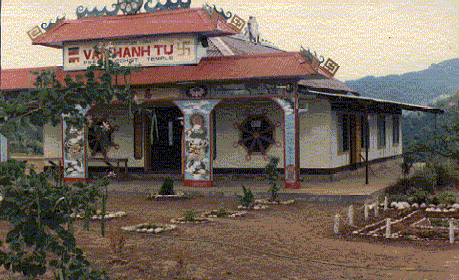
On one side was the grove of mango-trees
under which many a refugee had sought shelter from
the hot sun, and on the other were the ruins of the
temple we had established in ‘80-’81,
and which was later named Chua Van Hanh; the roof
had gone without a trace, probably to serve other
purposes in the nearby town of Morong. All that remained
were a few termite-riddled pillars that crumbled to
the touch, and the Buddha-image— also created
by Do Ky — gazing impassively on the desolation.
It would have taken too much of an effort
to force our way through the weeds and thorns to where
we might look out over the stream and forest behind
the temple, so we didn’t even try. We did, however,
uncover two cement seats I had set up, with the inscriptions
on their tops still legible; one of them read: "The
Law of Life is Change ….. " One seat had
cracked in the middle, and a seed had germinated therein,
giving rise to a flourishing tree. I had a vision
of someone stumbling upon this place centuries in
the future, long after it had been forgotten, and
thinking they had discovered the remains of an ancient
civilization.
We proceeded up through the Camp, passing
the place where the Catholic Church had stood; this,
too, had gone, but the image of Mary, atop a globe
of the Earth, remained. The Camp hospital was there,
closed but not overgrown. Next was the Administration
Building, with some activity inside; what it is now
used for, I was unable to ascertain. Then there was
the ICMC building, where the basic-English education
of the refugees had its nerve-center. Nearby, too,
was the Camp Post Office, which I had nick-named the
‘Lost Office’ because of the large amounts
of mail that used to go ‘missing’ there;
there are always people to take advantage of any situation
to enrich themselves, seemingly unable to put themselves
into the positions of those they exploit; what they
would not like others to do to them, they are quite
willing to do to others.
Up then, past Freedom Plaza and the refugee-boats
that had been brought from the coast nearby rotting
away, those who had escaped from Vietnam in them long
settled in other lands; one was little bigger than
a rowing-boat, without cover; how brave or foolhardy
were the people who had risked everything to cross
the sea in that! Many thousands— how many, will
never be known— perished in their quest. Life
must have been so hard in their homeland for them
to embark upon such a hazardous venture!
Following the road onwards, it was hard
to imagine that 18,000 people at a time had lived
here; their billets had gone without trace, bulldozed,
I was told, some years back. The Camp had been divided
into ten neighborhoods, each neighborhood having thirty
buildings, with ten billets each, and each billet
accommodated six people or more; there they cooked,
ate, slept, studied, worried, argued, fought, played,
sang, loved, planned, prayed, dreamed, and made do
with what they had. During the time I spent there,
over 100,000 people from Vietnam, Cambodia and Laos
passed through, most spending about six months there,
but some getting stuck and having to wait much longer;
there were others, too, who never left the Camp, but
were resettled, sooner than they expected or wanted,
in what came to be known as Neighborhood 11: the cemetery.
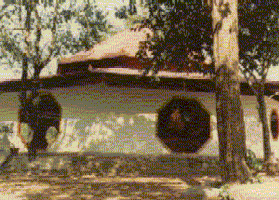
The temple at the top end of the Camp, near
Neighborhood Two, was in better shape than the other
one; at least, the roof was still on, but the fibro-cement
walls, on which the Cambodians had painted scenes
from the life of the Buddha, had been smashed; some
fragments remained, hanging on the framework. This
temple, more than the lower one, bore the marks of
my hands, as I had done a lot of work on it myself,
and constructed it more sturdily; the octagonal window-frames,
that I had decorated with bodhi-leaves, were still
there. The main painting of the Buddha behind the
altar had been partly-destroyed and wore campaign-posters
of some politician; one of the Buddha-images had been
decapitated.
I searched in vain for the hut I had built
and lived in, but was unable to find even the cement
floor. I looked, too, for two coconut trees that had
grown from nuts left over from some festival we had
in 1980, expecting them to be quite tall now, but
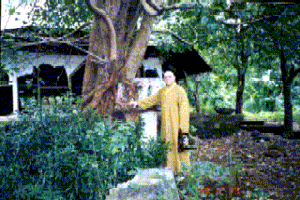
they had also gone. The Bodhi-tree, however, which
I had brought as a tiny sapling plucked from a wall
in a temple on the island of Cebu in 1979, and planted
in the Camp in 1980, was now big and tall; this tree
had been inexplicably cut down by a crazy monk shortly
after I had left the Camp, and resulted in the Cambodians
taking over the temple from the Vietnamese, but had
regrown and was in the process of wrapping itself
around and absorbing a small shrine the Cambodians
had erected against it.
A Buddha-image— the one made by the
Vietnamese when they established the first temple
there in 1980, shortly after the Camp opened—
sat in a shed at one side of the temple, together
with a larger-than-life image made by the Cambodians
later.
Around the trees in what had been the temple-compound
were the stones we had positioned there to serve as
seats that termites couldn’t eat; it was hard
to imagine that this area had once been clean and
neat.
I walked up to the crest of the hill behind
the temple, hoping to look down on where the Camp
had been, but this was not possible owing to the trees
and shrubbery that enshrouded everything. It did not,
however, prevent memories from flooding back into
my mind. I ‘saw’ many old faces there,
and thought of their stories, each of them unique;
I wonder where they all are now.
Four years of my life I spent in this Camp,
watching people come and go, some with little more
than the clothes they were wearing. Some few I have
seen again in places like the U.S., Canada, France,
Germany, Denmark, Norway and Australia; they have
changed the world wherever they went, and in turn
have been changed.
Life goes on, flows on, like a river, often
with no sense of direction, not knowing where it came
from, where it is, nor where it is going. We think
we are in control of our lives, but are not, and even
small things, unexpected and sudden, can change us
considerably. If we learned to look at life as an
adventure, instead of clinging to it with fearful
self-concern, we could enjoy it much more than we
do. If, too, we would give up the idea or desire that
everything should be nice, and tried to see the good
in it instead, we would learn more than we do. There
is white in the black, always. I met people in that
Camp (and in other Camps), who were quite happy there;
not all of them were sad. I also met people later
on, in the lands where they had resettled, who told
me that they would like to be back in the Refugee
Camps, where life was simple and uncomplicated.
My thanks to the kind people who drove me
out on my trip of reminiscence to Bataan, and my Best
Wishes to all the refugees who passed through that
Camp on their way to other lands; they became part
of my life just as I became part of theirs.
"That’s
what learning is. You suddenly understand something
you’ve understood all your life, but in
a new way".
Doris Lessing |
|