So Many Roads ~ EARLY YEARS
“Listen to the rhythm of
the falling rain,
Telling me just what a fool I’ve been.”
Nice
song. But rain always reminds me of the many times
during my hitch-hiking years long ago, when I stood
out in the rain ~ drizzle, steady, downpours ~ beside
the road, waiting for a lift; but when you’re
wet and bedraggled, few people are willing to stop
and take you.
That was long ago, but I traveled in many countries
that way, on the kindness and generosity of others.
And really, when you think about it, it is a form
of begging, as we did not pay for rides ~ rides in
all kinds of vehicles, from luxurious to bone-rattlingly
uncomfortable and dirty ~ anything to get us where
we wanted to go in the cheapest way possible. It was
relatively easy in those days, although I’ve
stood for long hours waiting for a ride. My record-wait
was 43 hours, on the Turkish-Bulgarian border, but
I had more patience then than now, and didn’t
really mind, because being September, the weather
was fine, and there was the shell of a building where
I could sleep at night, and a simple shop nearby where
I could get bread and cheese; also, I had a good book
to keep me occupied: Michener’s The Source,
that I’d bought from another traveler when he’d
done with it.
Finally, I got a ride to Plovdiv, Bulgaria’s
second-largest city, but like the rest of that country
during its long years under commu-nism ~ and it was
the only communist country I went to ~ it seemed gray,
drab and anaemic. How I went on from there I do not
recall, as my treks around Europe were so numerous
~ back and forth in my search that wasn’t yet
a conscious search but almost aimless.
But how come I’d set out and found myself living
the life of a rover? I am not of a family of gypsies,
or diplomats who are posted to various parts and find
themselves in unusual places without having much choice
in the matter. It’s a strange story, and if
someone had told me, as a boy, that this is the life-style
I would take up and see the world like the young men
of the fairy-tales who set out to seek their fortunes,
I wouldn’t have believed it. Was it my destiny?
Perhaps it was, as looking back, I can see that I
was always different, not because I wanted or tried
to be ~ I didn’t, and it was damned hard at
times, and still is, to be dif-ferent ~ but because
the pattern seemed to be set, the die cast.
I decided to call my memoirs SO MANY ROADS,
answering the first question posed by Bob Dylan in
his famous protest-song, Blowin’ in the
Wind, the full text of which I will reproduce
here. Dylan had a great influence on me, and I still
like his old songs.
“How many roads must a man
walk down,
Before you call him a man?
How many seas must the white dove sail,
Before she can sleep in the sand?
How many times must the cannonballs fly
Before they’re forever banned?
The answer, my friend, is blowin’ in the wind;
The answer is blowin’ in the wind.
How many years can a mountain exist,
Before it is washed to the sea?
How many years can some people exist,
Before they’re allowed to be free?
How many times can a man turn his head,
And pretend that he just doesn’t see?
The answer, my friend, is blowin’ in the wind’
The answer is blowin’ in the wind.
How many times must a man look up,
Before he can see the sky?
How many ears must one man have,
Before he can hear people cry?
How many deaths will it take till he knows,
That too many people have died?
The answer, my friend, is blowin’ in the wind;
The answer is blowin’ in the wind.
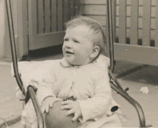
(Earliest picture of me)
Why I was born where and when I was born, I cannot
say, as no-one knows these things; and it wasn’t
until many years later that I began to question them,
with some surprising insights. From an early age,
however, I was always an avid reader, fol-lowing my
father in this and in other ways; he was an inveterate
patron of sales-rooms and used-book-stores, and would
come home with all kinds of treasures ~ boxes of books,
antique furni-ture, inlaid tables and cabinets, tools,
machines, and so on ~ because after WW2, when Britain
was virtually bankrupt, estates were being broken
up and sold; he would get things for next to nothing,
and space to store them was no problem, as we lived
in an old farm-house with its out-buildings, although
we were not farmers ourselves, and it had long ceased
to be a farm.
My mother was born in that village ~ a lovely place
called Bur-wardsley, in Cheshire, with hills, forests,
fields, streams and ponds ~ but dad was from Derby.
While he was a child, his fam-ily had moved to Liverpool;
he never lost his Merseyside accent; nor did he ever
become a country person, although he moved from city
to countryside after marrying my mother (they’d
met while she was working as a house-maid in Wallasey);
his gar-dening extended to just weeding, which he
was pretty good at, but he didn’t grow things
as did my mother; she was green-fingered,
not dad. He was good at mechanics and woodwork, and
indeed, by profession, if you can call it that, he
followed his dad, and was what he liked to call a
‘saw-doctor,’ making, sharpening and setting
saws ~ a handy man to know if you had a saw that wouldn’t
cut.
His workshop ~ one of the old farm-buildings ~ was
huge, with an upstairs we used to call the
loft, reached by a ladder through a trap-door,
and which, with all his cheaply-acquired stuff, was
a veritable Aladdin’s Cave. I used to love going
up there as a boy and looking at his latest finds
~ and his earlier ones, too ~ and when, later on,
he used to lock it to keep me and my younger brother,
George, out when he was at work, we found a way in
anyway, circumventing his locks.
Believe it or not, our house ~ like many others in
the village (and no doubt many other villages in Britain)
~ was without electricity; we used kerosene lamps
for lighting, and cooked on a wood-burning stove which
was later replaced by a coke-burning ‘range,’
that not only heated the living-room but also a boiler
that dad had fixed up; it was very efficient. It heated
only one room, however, and in winter, the rest were
bitterly cold, and we used hot-water-bottles in bed
at night to mitigate this. Parts of the house were
over 150 years old, with low and sagging ceilings
that creaked a lot, and small bedroom-windows that
let in little light. Nowadays, such houses ~ those
that remain and which have not been demolished, as
ours later was ~ have been bought up and renovated
by people moving out of the towns, and are hardly
recognizable.
I was the fourth of five children. The eldest was
Sheila, 12 years older than me; then came twins, Bob
and Glen, two years after Sheila. Then me, followed
by George.
Before going on, I should say that this house was
haunted. Of-ten, even in the daytime, we heard footsteps
going up the stairs and in and out of the three bedrooms;
in the daytime, I dared to go and look, but there
was no-one ~ although I won’t say nothing
~ there; our cats and dogs (we always had pets), would
hide somewhere when they heard such sounds. One night,
I was in bed but not yet asleep, with the door of
my room open, when suddenly, in the doorway, appeared
this thing. It was man-sized and man-shaped,
but like smoke. It did not do anything, but I was
petrified, and couldn’t even shout or scream.
How long this lasted, I can’t say, until it
disappeared, and I returned to normal. I did not know,
then, that Glen (short for Glenda, which was so formal,
like my own name, Michael, which I never liked), ten
years older than me, had seen it in the same room
years before; she’d heard it coming, until it
came into the room, but she had the presence of mind
to get under the bedclothes and almost stopped breathing,
until she plucked up enough courage to peep out, and
it had gone. We never found out anything about this
apparition, but apparently, the previous tenant of
this house had been a miser and had died there; had
he got stuck there be-cause of that? Several other
houses in the vicinity were reput-edly haunted, and
I could understand it. Belief in ghosts is world-wide,
but for some reason, England is well-known ~ more
than any other country I’ve been to ~ for its
ghosts; I wonder why?
At weekends and other holidays ~ weather permitting
(and I don’t recall it raining as much then
as it seems to do now) ~ my younger brother and I
would leave home in the morning, with sandwiches packed
by our mother, and cover many miles before coming
home in the evening, tired but happy from the day’s
ad-ventures, with something or other in our pockets
or over our shoulders. Our parents didn’t worry
about us; it was just the way things were; there was
almost no crime in our area then.
There was one spot in the woods that I particularly
loved: a rocky outcrop that soared like the bow of
a ship above the waves of the tree-tops. I would sit
there, dreaming away, and even scratched my name in
the rock. Far below was a farm-house among the trees
and patchwork fields; I used to call and wave to the
people there, and they would wave back. In the for-est,
on the other side was a castle ~ a mock-Norman fortress,
built only 150 years before ~ and on the far side
of that another, Beeston Castle, which had undergone
siege by the Parliamen-tarians during the Civil War
in the 17th century.
Although I don’t remember it, Britain was under
food-rationing after the War (until now, it’s
still spoken of as ‘the war’, as if there
was only one! It shows how, when we are involved with
something directly, it becomes ours, subjectively,
whereas other things ~ even though similar ~ are remote
from us and somehow not-so-real) for a number of years,
and not just during it; people couldn’t just
go out and buy whatever they wanted, even if they
had the money and food and other things were available.
It was an exhausted and impoverished nation I was
born into, but I’d known nothing else, of course,
and didn’t question it. Almost bankrupt, and
with its empire gone, it was years before Britain
got on its feet again. I have just seen this from
the Irish Times on the Net, dated Tuesday,
25th January, 2005:
“Lord Laird today received a parliamentary
answer indicating that $4,368 billion is still owed
from the First World War. The United States has not
written off these debts despite canceling the debt
owed by Ger-many.”
And that was from the First World War!
Nevertheless, we managed, and once a week, our parents
used to take George and I to the movies (we called
them the pictures in those days), usually
on Friday evening. After five dreary days of school,
it was really something to look forward to.
Chester, the nearest town to our village, had four
cinemas, the names of which ~ if I recall aright ~
were Odeon, Gaumont, Re-gal and Tatler.
Near each was the inevitable sweet-shop, into which
we were taken before going into the cinema, and given
free choice. Supplied then, with a bag of sweets and
chocolate, we would enter the dark womb of the cinema
and join the hushed and expectant crowd waiting for
the movie to begin; it was another world; we were
about to embark upon adventures.
One movie we saw was about the Yeti (otherwise
called The Abominable Snowman) ~ a gigantic,
hairy anthropoid which leg-end holds lives in the
snowbound fastnesses of the Himalayas. Now, yetis
are supposed to be shy and elusive, so none have ever
been filmed or captured, except in this particular
movie, which was only fiction and not true, of course.
An expedition went in search of this legendary creature,
and eventually, their Sherpa guides succeeded in tracking
one down and trapping it. It was then trussed up and
shipped off to London, to be exhib-ited as ‘The
Missing Link’.
Infuriated to the point where it could no longer bear
abuse, the Yeti managed to escape from its cage and
got into the London Underground (the Tube),
where it went on the rampage, venting its fury on
unfortunate commuters. Attempts to recapture it only
resulted in more deaths, until finally, it was shot
dead. End of movie. But not end of the effects of
it on me. I was so terrified by this creature, and
could not forget it. My other brother, Bob (Glen’s
twin), knowing this, took delight in scaring me further,
by telling me, just as I was about to go to bed: "The
Yeti is up there waiting for you!" This fear
lasted for a long time, and I don’t re-member
when I outgrew it. Eventually, of course, I had to
face and deal with my fear of the dark and ghosts,
because there were to be more experiences of them.
To fast-forward here: In ’94, I saw
this old film on Australian TV, and couldn’t
believe how I’d ever been scared of such a silly
thing; it was ridiculous; but at the time, so many
years before, the Yeti of the movie and the irrational
fear of it, were as real to me as the brother who
got his kicks by scaring a child in this way! Kids
do not know the difference between fear of real things
~ fear that can protect us from danger and harm ~
and fear with no basis in fact; to the child, it is
simply fear. To frighten kids with horror stories
and tales of ghosts is not just stupid and wrong,
but bad, and has a negative and sometimes long-lasting
effect on their impressionable minds. We should be
concerned with the cultivation of the mind, not with
its destruction.
Back again: Being the somewhat ‘mad-scientist’
that he was ~ another aspect of his eccentricity (this
is where I get mine from, no doubt, not from my mother)
~ dad decided to rectify our lack of electrification.
Always fascinated by engines and motors ~ and to give
credit where it is due, he was quite talented in this
area, and self-taught, too ~ he bought and installed
a huge gen-erator. Pity for the neighbors, whose house
was actually nearer to dad’s workshop than ours,
theirs being just the other side of the workshop,
while ours was separated from it by a sizeable yard;
and the generator made such a damn noise that any
envy they might have felt towards us because of the
benefits con-ferred by it was surely transformed into
rage by the terrible noise. They didn’t complain
~ at least, not to us ~ but must have hated us for
this and other things; they were sour-faced by na-ture
~ not just because of us ~ and we weren’t on
good terms.
Anyway, this generator changed our lives considerably,
and opened up the possibility of electric-light, and
dad, on his own ~ he knew about electricity, too,
but perhaps not enough ~ wired the whole house. Needless
to say, we thought it wonderful to have light at the
flick of a switch instead of having to prime and light
the kerosene pressure-lamps. It also enabled us to
get a TV ~ one of the first in the village (it’s
hard to imagine this now, much further down the track,
as memory fades with time). Any-way, although we were
by no means wealthy, we were always among the privileged
in the village, because as far back as I re-member,
we always had some kind of car, when not many other
people did ~ and this wasn’t Rip Van
Winkle country! Our first TV was very small, and black-and-white,
of course ~ no such thing as color TV then ~ but it
worked only when the generator was running, until
dad figured how to run it from car-batteries that
he’d charge, but they wouldn’t last long
before becoming flat, often in the middle of a program
that we particularly wanted to watch, it seemed, leaving
us frustrated and urging dad to go out and start the
generator, which he wasn’t always happy to do;
like he himself, it was temperamental and wouldn’t
always start when he wanted it to, and required much
swinging on the crank-handle, accompanied by quite
a bit of cursing ~ “Damn thing! Blast it! Bloody
Hell!” and so on. We soon forgot the wonder
of having things we’d not had before, and came
to expect them to be there whenever we wanted them,
and of course, this was not the case; sometimes they
were there, and at other times not; it’s so
easy to become addicted to things ~ dependent
upon them ~ and take them for granted. We managed
before having a TV, but suffered more after having
it when it wouldn’t work; like this, having
things is a mixed blessing; suffering is inherent
in having things, because often it turns out that
the things have us!
Next in line, after electric lights and TV, were electric-blankets,
making our hot-water-bottles obsolete. But dad’s
know-how was a bit deficient here, and talk about
execution by electric-chair, we were nearly executed
by electric bed! Lucky, too, that the house
wasn’t set on fire, as the voltage produced
by this mas-sive generator was far in excess of that
required by the electric-blankets, and before long,
they began to show burn-marks.
There were down-sides to dad’s inventiveness,
and as I got older, I began to notice and focus on
them. At first, I thought he could do anything, and
idolized him, so that when, in primary school, our
teacher once asked us if anyone knew what a hero was,
I immediately raised my hand and said: “I
do, sir. My dad’s a hero. He killed a gorgon!”
(One of the tales our fabulously-yarn-spinning
dad had told us, you see, was that, during his mili-tary-service
in Greece or Italy during the War, with a grenade
he had killed this gorgon, which I had taken to be
some kind of dragon, unacquainted as I yet was with
the creatures from Greek mythology with snakes instead
of hair, and whose fear-some visage was so awful that
anyone looking upon it was straightaway turned to
stone). Well, the teacher was diplomatic and didn’t
disillusion me or make fun of me, and the other kids
in the class were just as ignorant and naïve
as me, so nobody laughed, and I was left with my illusions
intact for a while. Later, when I became more discerning
and critical, I began to see that my dad couldn’t
do everything and wasn’t a hero, and I was bit-terly
disappointed, feeling that he’d let me down
and betrayed me, as I so wanted him to live up to
my unrealistic expectations, not realizing that it
was these expectations that had let me down rather
than him. But a child doesn’t understand such
things, es-pecially when no-one explains to him in
a way both simple and clear. These new perceptions
~ or rather, misperceptions, just as erroneous
as the previous set ~ were to determine the way I
thought of my dad for a number of years to come, in
a negative, deprecating light. What a pity, what a
waste of time/life! Only later, much, much later,
when I was living far away from him, did I realize
that my dad had never been a hero, but that he was
my dad, and although I have called several people
‘mother’ during my travels, I have never
called anyone else ‘dad’. In 1981, while
in the Philippines, I began to reflect about my relationship
with him, and made a cassette-tape of my thoughts,
and sent it to him; when they received it, both dad
and mum cried.
The primary school I attended was about a mile from
home, and we walked there, or later on went by bike;
those were days when people had no need to worry about
their kids being ab-ducted or molested, and did not
accompany them there or back. There were only two
classes in the school, one for the elder kids, conducted
by the headmaster, Mr. Ravenscroft [who we
re-ferred to as ‘Noggy,’ though I forget
why, as it bore no resem-blance to his name], and
the other for the younger ones by a teacher ~ usually
a lady ~ who generally didn’t stay very long,
and whose names, except for a Miss Solomon
and a Mrs. Laign, I no longer remember. Well,
I never liked school, and in fact, on the whole, hated
the experience, not because I was dull and slow to
learn, but because I didn’t like being made
to learn, and wanted to learn in my own good time
and way; the streak of stubbornness and anti-authority
was in me even then, and has persisted until now.
I was somewhat like Mark Twain, it seems, and preferred
the open air to being confined in a class-room. At
times I would think, “I’ve had enough
of this wretched school to-day,” and at lunchtime
(I soon gave up having the subsidized school meals
as I couldn’t stand the stench, let alone the
taste, of the meat ~ usually beef ~ that was dished
up!) I would go off into the nearby woods, and when
classes resumed and Noggy asked where I was, some
snitch ~ of which there was no short-age; there seldom
is ~ would say, “He’s gone off into the
woods.” Now, twice that I remember, Noggy brought
out the en-tire school to search for me (I guess it
was a nice break for him, too). But I knew the woods
better than they did, and moreover, was very good
at hiding, so they would be all around me and not
see me. After a while, the search was abandoned and
they re-turned to school, and I, thinking how smart
I was to outfox them, went home. The next day, however,
I had to go to school again, and the teacher was waiting
for me with his cane, which made me less happy than
before, and left me feeling not very well-disposed
towards him. It seemed to me that I was the one who
got more canings than anyone else in my class.
Once, after one such escapade and they’d all
given up and re-turned to school (I bet there were
others who envied me, though), on the way home, I
stopped to pick pears from a tree in a field near
my home, and returned with my shirt bulging with fruit.
But my parents had already been notified that I’d
done a runner and were waiting for me, so as soon
as I walked in the gate, dad grabbed hold of me saying,
“Come on, you little bug-ger!”, and unceremoniously
bundled me into the car and took me back to school,
where I was exposed to the gaze of every-one, like
Louis XVI on his way to the guillotine. I was, needless
to say, subdued but not deterred for some time after
this.
Strangely enough, I had an inbuilt fear of being late
for anything, and always went to school early, getting
there before everyone else; anyone would have thought
I loved the place and couldn’t wait to get there,
instead of the other way around! Often, I used to
read a book as I walked. Well, one day, someone whose
house I had to pass on my way decided to play a trick
on me, and said, “You’re late; they’ve
gone in already!” I ran the rest of the way,
only to find myself first there, as usual.
Many years later ~ about the same time I made the
tape for my dad ~ I wrote a letter to my old teacher,
and would like to repro-duce it here to show that
I’d learned something from him at last:
Dear Mr. Ravenscroft,
I’ve not written to you for quite some time,
and there is something I would like to say. Would
you mind if I tell it as I of-ten tell it to the refugees
in the Camp here?
When I was a boy, I hated going to school, not because
I was dull and incapable of learning, but maybe because
I did not like being made to learn. I was a naughty
boy, and sometimes used to play truant; perhaps I
was the naughtiest boy in the school ~ I cannot think
of anyone who was naughtier; I was caned many times.
When I left school, I was very happy to do so, but
now, after all these years, I realize that I never
left, and that I am still in school, but that the
school I am now in has a roof but no walls ~ the sky
being the roof. There is a difference now, though:
I enjoy learning; my life, day-by-day, is an adventure,
an unfolding, a journey of discovery.
I learned many things from you, and some of the things
I learned have surfaced only in recent years, so long
after. And did you not explain to me that what is
not in a painting is just as important as what is
there? This is redolent of Eastern philosophy ~ Chinese
in particular. Like the empty space between the notes
of music, or between words: without the space between,
there would be meaningless confusion. Did you ever
study Eastern philosophy, Sir?
I’m writing this to express my belated gratitude
to you for your pa-tient efforts with me (even the
canings were good for me ~ maybe I should say: especially
the canings!) It takes time for a seed to germinate
and grow; it does not immediately become a fruit-bearing
tree. As I look back, I don’t know why I didn’t
receive more canings; I certainly deserved them! Now
I am somewhat in the position that you were then,
and I un-derstand how difficult it is to be a teacher
trying to impart knowledge to others. People call
me ‘Sir’ now, and expect me to know things
that they don’t know. Well, what I feel I have
to say is that we should break out of the habit of
always waiting to be taught, and, in all humility,
become learners ~ which is something quite different
than being students, wouldn’t you say? I feel
that everything is trying to tell us something; should
we always think that all knowledge lies in a person
or persons? The nature-studies we had in school were
excellent lessons; I only wish there had been more
of them.
Once, I had a desire to become a history teacher,
but that never came about. Now, although I realize
that the present rests upon the past, like the snow-cap
on a mountain-peak, I have lost interest in history
as it is recorded ~ after all, it is ‘his story,’
and is often biased and distorted. To be sure, there
are many things that we can, and should, learn from
the past in living in the present, but it has gone,
beyond recall, and cannot ever be changed. There is
only one 6-Aug-1982; there has not been such a day
before, and there will never be another. Life, with
all its pain and sham, is still worth living, as long
as we learn something from it; we will then not depart
empty-handed.
(Bataan Refugee Camp, Philippines. 6-Aug-1982).
Since I wrote that letter in ’82, there have
been many changes, of course. One change in me has
been a resurgence of my in-terest in history, because,
although it is no less true now than then that recorded
history is his story, the past is an immense treasure-trove
for us to enrich ourselves from. We can make sense
of the present only by means of the past; otherwise,
it has no meaning.
The present is the past, with a little added to it;
without it, there would be no present. Perhaps we
may compare it to a coral-reef, slowly and imperceptibly
being built up by countless tiny polyps. The past
has not gone, as many of us think, but is still here,
speaking to and teaching us in so many ways, and we
are greatly indebted to it. Whatever we achieve, it
is not simply by our own efforts, but because we are
enabled to do so by others before us; by ourselves,
alone and in isolation, we can do noth-ing. Being
members of the human race should inspire us to con-tribute
whatever we can to its continuous unfolding.
Another teacher ~ a lady whose name my brain hasn’t
yet yielded up ~ used to take me aside after lunch
and give me ~ only me, no-one else ~ extra tuition
in reading. Why she did this, I never knew, because
she didn’t tell me (it wasn’t because
I was backwards, either, as there were greater dummies
than me), but I was certainly grateful for it, and
still am, as the won-derful ability to read and write
opened many doors for me and continues to do so, and
if I’d learned nothing more than this in school,
it would have been enough. May she be well and happy
wherever/however she may be now.
Something else I remember from those days was a small
lump in the asphalt of the playground. As the months
passed, this lump slowly got bigger, until, like a
cake in the oven, it cracked, and some time later,
a blade of grass appeared. This might have been my
first awareness of nameless Dharma. How long the playground
had been there, I don’t know, but some of the
grass beneath it hadn’t died, and had tenaciously
forced its way to the surface and the light. It obviously
struck me as somehow signifi-cant for me to remark
upon and remember it.
At the age of eleven or a little older, we had to
sit what was known as the ‘11-Plus Exam,’
which determined if we would go on from primary-school
to grammar-school, or to what was called secondary-modern.
Well, we were such hayseeds that only two people in
our village that I knew of passed this exam ~ David
Harding and William Dawson ~ but I almost
did, and got a second chance. Mr. Ravenscoft was always
rather proud about this, and though I failed the second
time (and wasn’t sad about it, either, because
I know I’d have hated grammar-school even more
than primary and secondary), he used to say that I
was a ‘borderline case,’ and meant it
as a compliment.
Anyway, after this, and before I transferred to the
secondary-school in the next and bigger village 3
miles away named Tat-tenhall, one day every fortnight,
the older boys and girls were bussed there for woodwork-
and cookery-classes respectively, and the kids at
that school were waiting to rag us country bump-kins
unmercifully; one of the first ordeals newcomers had
to face was called ‘ducking’ ~ having
our heads pushed under the taps in the washrooms.
And I, who have worn glasses from the age of ten (which
was when it was discovered I was short-sighted), came
in for extra teasing, as kids who are different in
any way often do (not many kids wore glasses then,
and though they en-abled me to see better than I otherwise
would have done, in some ways they were a handicap;
they were broken many times, especially during the
winter, when snowballs thrown with some force ~ and
sometimes containing stones or lumps of coke ~ would
come smashing into them).
Anyway, four months short of my 13th birthday, I started
at that awful school full-time, and was assigned to
a ‘B’ class with other dummies, but after
a couple of months it was already summer holidays
~ what bliss! ~ and when we returned six weeks later,
everyone’s name was read out during assembly
and told which class they’d be in that school-year.
One by one, people left the hall until I was the last
one left. I remember sitting there anx-iously waiting
for what seemed like forever until my name was called
~ by a process of elimination, perhaps? ~ and I was
as-signed to an ‘A’ class. I almost peed
my pants!
Without a doubt, holidays were always the best part
of school for me, and anticipation of them ~ as of
most good things in life ~ was almost as enjoyable,
if not moreso, than the actual holidays when they
came. During the summer-break, mum and dad took George
~ younger than me by almost two years ~ and I to a
sea-side resort named Talacre for a fortnight
(the others were already working by then), where we
stayed in a rented chalet (or rather, shack) among
the sand-dunes; in this, again, we were fortunate,
as most people in our village couldn’t afford
such rela-tive luxury. Most times, dad would continue
his work and join us now and then, as the resort was
only 40 miles from our home. We lived simply in our
holiday-shack, as there was no electricity or running
water; we had to get our water from taps placed at
long intervals along the roads, and join the queue
for it when it started to run, inching our buckets
and other containers forward until it was our turn,
and lugging the precious liquid home, with several
rest-stops along the way.
I always loved nature, and was given to solitary musings.
It was not unusual, therefore, for me go off on my
own at the beach and sit or lie quietly in the dunes.
There, I would listen to the sky-larks sing high above,
and strain my eyes to locate them; I could hear them,
but where were they? Why did they fly so high to sing
like that? Such a beautiful sound ~ I can hear it
now!
The unspoiled beach stretched for miles and miles,
and sloped gradually, so that the sea receded far
out, then returned almost to the dunes; these were
covered by rushes with spiky tips, which would break
off in your skin and fester if you brushed against
them; among the rushes, here and there, were patches
of sea-holly, and black-berries with fruit and thorns.
A light-house stood on the beach, alone, aloof, mysterious,
unoccupied, and slowly lapsing into ruin.
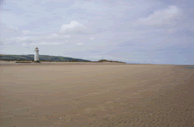
Talacre Beach and the Lighthouse
Mum led us to catch fish, and at low tide
would stretch a line with baited hooks between posts
embedded in the beach, then return to see if there
were any unlucky fish when the tide had risen and
gone out again; but we were either poor fishermen,
or the fish were too smart; we never caught many.
Vans used to drive around selling various things holiday-makers
might need: bread, ice-cream, milk, and so on; I can
still hear the call one of them made: “Calor-gas-man
caw-lling.”
We had many happy times at Talacre. Dad had a huge
airplane inner-tube obtained from one of the junkyards
he used to visit, and would inflate it for our fun
on the beach; we used it for some years, until one
of us nearly got carried out to sea on it, and that
was the end of it.
I got a job in ~ believe it or not! ~ a butcher’s
shop in Tattenhall, accompanying him on his delivery-rounds
on Saturday morn-ings. I hated it, but it provided
me with some pocket money ~ five shillings each time.
We had quite a large plot of land behind the house
that we called ‘the orchard,’ although
apart from a few fruit-trees, it really didn’t
deserve that name. My mother always kept hens for
eggs, and for some years bees for honey (she’d
have a go at any-thing). In my early teens, she bought
a rotary hoe, and with this I plowed up not just her
regular garden-patch ~ already quite large ~ but also
most of ‘the orchard,’ and we had bumper
crops of potatoes, cabbages and other things from
it.
There were two places of worship in the village: the
Anglican church and the Methodist chapel. People were
divided in their loyalties between them, although
there was little difference in belief. My family ~
led by mum ~ went to chapel (we didn’t call
it ‘church’; it was chapel, and nothing
else). It was, for me at that time, rather boring;
you could count on seeing the same people there week
after week, and people were noticeable if they didn’t
turn up. Present would be David Dodd, who invariably
nodded off during the sermon, grumpy old Eric Chesters,
a farmer who used to yell if he saw us in his fields,
though we were doing no harm, and Mary Hastle, the
organist. My mother was active in the chapel, and
often used to conduct the services. The whole service
lasted an hour, and consisted of 2 prayers, 3 hymns,
some announcements, and the sermon, which should not
have gone on for longer than 20 minutes, and if it
did, people would become restless, coughing and looking
at the clock on the wall, wondering when it was going
to end; it was a formality; the con-tent wasn’t
important. Such was my religious background, and though
I was later to abandon and reject it, I learned something
from it, and am grateful.
To side-track a little here: One of the ministers
at the Anglican church we knew as Canon Vaughn;
he was rather a nice man, and used to visit more-or-less
everyone in the village, whether they went to his
church or not, which makes it all the more strange
why one time, as he was passing near our house, I
called out to him: “I don’t like you,
and I don’t like that hat, and neither does
my dad!” I think he was quite amused, as he
told my dad what I’d said, and I don’t
think I got into too much trou-ble. We used to laugh
about this in later years.
All too soon, the holidays came to an end
and we had to return to that dratted school, which
I had to endure for another two years, leaving there
two months before my 15th birthday. Now, one boy ~
Philip Benson, by name ~ left school 6 months before
me, being slightly older, and he cried ~
there were tears coming down his cheeks ~ and I stood
looking at him and thinking, “Are you mad?
Crying about leaving school?!” I was
so happy to leave there, not a moment too soon, but
not before my mother ~ who must have had great hopes
for me, as I was the only one of us she did it for
(she was financially unable to do it for the others
before me, but since then, had got the job of cook
in the pri-mary-school) ~ had arranged with the headmaster,
Gordon Rigby, who I actually quite liked ~ for me
to go on to what was known as a ‘College
of Further Education’ (a glorified name
for what was really a high school) in Chester, for
two years, starting that September (1961). That summer
passed, like all summers do, and I started College
with a sense of pride in the name, as if it was some
prestigious establishment; I guess I needed that boost
to my self-esteem, foolish though it was. I left my
old friends behind ~ the few I’d had ~ and formed
new associations, though none of them of any depth
or duration.
By this time, Sheila had married someone from Chester
and was living in a council-house in a not very salubrious
area, and sometimes, so I wouldn’t need to go
all the way home by bus, and in order to baby-sit
her children when she and her husband, Frank,
wanted to go out, I would stay overnight with them.
Feeling the need to get another Saturday job, I went
to Wool-worths. "What’s your edge?"
said the fierce personnel manager. "Edge?"
I repeated, timorously. "What do you mean?"
"Edge!" he roared, in his strong
Yorkshire accent; "How old are you?!" "Oh,
sixteen," I hastily offered, realizing he’d
meant ‘age’. "You’re a bright
spark, aren’t you?!" he said sarcastically.
Thus began my relationship with this tyrant, and it
didn’t improve over the year I spent there,
working all day for just £1. Well, Jacko; I
never imagined you’d come into my life again,
but there you are, still with me!
My arrangement with Sheila and Frank went on intermittently
for some years, long after I’d come out of ‘college’
with a few bits of paper known as ‘O-Level’
certificates (I didn’t bother going on for ‘A-Levels,’
let alone university), until at one point, I moved
in with them full-time in a better area; but though
I always got on well with Sheila, I never did with
Frank, who was from a cold and emotionless family;
I don’t remember seeing any of them smile. I
got the feeling he resented me as a challenge to his
masculinity, funny man! But they needed me as much
as I needed them, be-cause in order to earn more money,
Sheila had a part-time job in the bar of what was
for Chester at that time a rather classy hotel named
Mollington Banastre ~ classy in the sense
that it was more-genteel than an ordinary pub. And
because Frank often worked late at his job, they needed
someone to baby-sit their kids, who were old enough
to be left without their mother. But what a task this
was, as they were real brats ~ boy and girl, Stu-art
and Anita ~ and used to play me up something awful.
Granted, I wasn’t the ideal person to be left
in charge of kids, starting when I was just 15, with
no experience of this kind of thing, but when I’d
shout at them and tell them to sleep instead of playing
around ~ as they did only when their parents were
not there ~ the next day, they would tell their mum
and dad, “Uncle Mike’s been aggravating
us,” and Frank, who was never sympa-thetic towards
me anyway, would naturally take their word against
mine, but wouldn’t say anything to me; instead,
being the kind of man he was, he’d tell Sheila,
but I knew, from the vibes, how it was; and the brats
knew this, too; they were not nice kids, and they
grew up into not-nice adults, too.
By the time I left ‘college’ in ’63,
I’d become fashion- and music-conscious. In
the early ‘Sixties The Beatles exploded
into fame, and what an impact they had! They didn’t
start a revolution, as they got their inspiration
from others before them, like Elvis Presley, Lonnie
Donegan, and so on ~ people who had never and would
never, do anything to me (I never liked Elvis) ~ but
they certainly gave it a greater impetus than it had
hitherto had, and I here acknowledge the change they
brought into my life. Unable to express my thoughts
or feelings (did I really have any to call my own
at that time?), it was just what I needed to identify
with, and I began to feel alive, as if I’d just
been existing or sleeping before, and had woken up;
color came into my other-wise seemingly black-and-white
~ and until then, meaningless ~ world. I’d had
no interest in politics or world-affairs before, and
looking back now, the first thing of prominence I
remember was the assassination of JFK in November
‘63; after that, my world became much bigger
than it had previously been. At the time, I’d
just joined Sheila in the hotel where she worked ~
she’d got me a part-time job as a waiter, and
it was there one night when the announcement came
through on the radio about the event in Dallas, and
a hush came over the bar. My job there didn’t
last long, however, as it was discovered that I was
still only 17 ~ too young to work in a bar ~ and so
it was with regret that I was ter-minated until I
should come of age.
Soon after this, I moved to stay with Glen in Crewe
~ 30 miles from Chester ~ where she’d gone to
live with the man she’d married from that town,
a rather drab town whose only claim to fame was its
railway-junction, locomotive works and beautiful park.
They had two young boys by this time, Anthony and
Alan, who were better behaved than Sheila’s
kids. I always got on well with Glen, too, and in
fact, she’d been like a surrogate mother to
me when I was small, taking care of me when mum had
newly-born George on her hands. She and her husband,
Dennis, took me in, and I got a job in a
retail-clothes shop, and earned enough there to pay
my keep and buy enough clothes to dress fashionably
and go out dancing. I had several girlfriends at this
time, but nothing serious.
That job lasted some months and then I moved
to a factory that made exclusive Saville Row clothes,
but although I earned more money there, working overtime
whenever possible, I didn’t like the experience,
as some of the people with whom I worked in the warehouse
were petty-minded, mean and malicious, and soon picked
up on the fact that I was not of their kind, and be-gan
to make my life miserable.
|