So Many Roads ~ 1967, A GREAT TRIP
“Living is easy, with eyes
closed,
Misunderstanding all you see.”
John Lennon, “Strawberry Fields
Forever.”
My
third and one of my best trips ~ best because it opened
things up for me and gave me a glimpse of my future
directions ~ began in Spring ’67 when, passing
through France and Swit-zerland, I got to Venice for
the first time and fell in love with the Sinking
City. Staying in the Youth Hostel on Giudecca
Island, I met other travelers. There was Dutch Tom
who made his living by playing flamenco-guitar on
the streets. There was Erwin from Austria, with whom
I became friends, and Rene, from Zurich, with whom
I formed a partnership busking; he was the guitarist,
and I the vocalist, with my repertoire of Beatles’
songs. I had quite a good voice, and together we made
enough for our daily expenses while doing it, at least.
Those were good days, until some policemen suddenly
arrived and busted us; we were not jailed or anything
like that, but told to leave Venice without delay.
Believe it or not, we complied, not daring to defy
them at that time ~ we were not tough guys ~ but a
couple of days later, we returned from Trieste and
resumed our busking until we decided we’d had
enough and moved on.
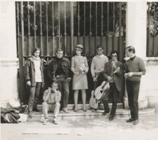
Group of friends in Venice in ‘67
Saying goodbye to beautiful Venice, with
its many fond memo-ries, therefore, we set out and
got to Ljubljana in Slovenia (one of the
republics comprising Yugoslavia at that time), and
were there approached by some young guys on the street
who wanted to practice their English, and invited
us to stay overnight in their home; such invitations
were always readily accepted, as we had nowhere to
stay. We were treated very kindly, and I kept in touch
with this family from thereon.
We stayed overnight with them ~ the Kavseks
~ then, saying goodbye to them, we resumed our journey,
and got rides on-wards through Croatia and Serbia
until, in southern Yugoslavia, a Mercedes stopped
for us; we couldn’t believe our luck! It was
driven by young Germans going to Beirut. We had a
ride right to Istanbul, through Bulgaria. Crossing
the Turkish border, we were in really different territory,
in contact for the first time with living Islam. I’ll
never forget my entry into Istanbul a few hours later;
first, we passed through the ancient Byzantine walls
and drove down the main street ~ Divan Yolu
~ past the Grand Covered Bazaar and Constantine’s
Column, until we were dropped in the Sultan
Ahmet area, where the magical domes and minarets
of Hagia Sophia and the Blue Mosque
dominate the skyline. We walked where the hippodrome
and the fabulous palace of the Byzantine emperors
had stood. Hagia Sophia was the largest Christian
church in the world when built by the emperor Justin-ian
in the 5th century, and remained so for many centuries,
until it was converted to a mosque after the Ottoman
Turks captured Constantinople in 1453, and when Turkey
became a republic in the early 20th century, it was
turned into a museum, and the wonderful mosaics that
the Ottomans had whitewashed over, were uncovered.
Istanbul became my favorite city, and remains so until
now. The name was changed from Constantinople to Is-tanbul
only in 1930.
We got a room in a cheap hotel; in fact, Istanbul
was the cheap-est place for accommodation, food and
other things that I’d yet been to, and on top
of this, I loved it for its tangible sense of his-tory
and its incomparable setting. There we met other young
travelers; it was already a place where people on
their way to and from the East ~ meaning Afghanistan,
India and Nepal ~ would rendezvous and rest up for
a few days after a tiring trip. It was also rather
dangerous as hustlers would approach you on the street
and hiss, “Hashish? Hashish? Wanna buy hashish?”
You had to be very careful if you wanted to buy
this commodity, as some of these guys were hand-in-hand
with the police, and no sooner had they managed to
make a sale than they would signal to the police waiting
nearby. Many people ended up in jail that way. The
penalties for drug-use at that time were very heavy,
and the conditions in Turkish jails horrible ~ and
still are, by all accounts (the movie, “Midnight
Express” was not an exag-geration, but it upset
many Turks).
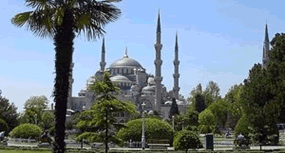
The Blue Mosque, Istanbul
Crossing the Bosphorus by ferry ~ the two
bridges were things of the future ~ we set foot for
the first time in Asia, a great feel-ing. Hitch-hiking
was not well-known in Turkey but we managed, and in
fact, found it not difficult at all, and within a
couple of days were in the south. It was Rene’s
plan to go to India, but although India had called
me from childhood, as I’ll later explain, I
didn’t feel ready to make such a journey. Just
how far I intended to go, I don’t recall, and
probably had no plans, but we crossed the border into
Syria, getting the visa there without any trouble,
and traveled through that land, where we found the
people very friendly and hospitable; we were not yet
aware of the rising ten-sions in the Middle-East,
and so had a carefree passage.
It was also easy to get a visa on entering Jordan,
and skirting Amman and crossing the river by the Allenby
Bridge ~ British-built during WW1 ~ we rode a bus
up the steep and barren hills of Judea to Jerusalem.
Now, with my Christian background ~ the only other
religion I’d had contact with at that time was
Islam, and I was not yet mature or interested enough
to make any comparisons ~ I felt quite moved to enter
this ‘holy’ city, and dur-ing my 10 days
there, it became another of my favorites.
We stayed in a small hotel, Holy Land House,
on a narrow street inside Herod’s Gate
by the name of Aqabat Darwish (Street of
the Dervishes), living on food we’d become accustomed
to in Syria and Jordan ~ humus (chick-pea
paste), pita-bread, and fa-lafel (deep-fried
chick-pea patties). Old Jerusalem was then part of
Jordan, as it had been since 1948, but this was about
to change. The Old City was really a place of atmosphere,
and even as I write of it now, the smells of the spice-bazaar
come back to me, and I can ‘see’ the narrow,
stepped streets and ar-cades, and hear the cries of
the yoghurt-vendors, “Leban-leban!”.
We saw the sights, of course ~ the Dome of the
Rock (built on the site where the Jews claim
their Second Temple was situated, and from where,
Muslims believe Mohammed as-cended to heaven by horse),
the Holy Sepulchre (where one of the attendants
said to me, “Hey, Mr. Hitch-hiker, stand in
line!” to get into the tomb itself); I also
went to the rival claim to the bur-ial-place of Jesus
outside the city-walls ~ the Garden of the Tomb
~ where there’s a tomb in a pleasant and
well-kept garden ~ as the name would suggest ~ against
a cliff, the features of which resemble a skull, consonant
with the Bible‘s name of the place, Golgotha:
Place of a Skull. This garden is said to have been
discovered by General Gordon (of Khartoum fame). It
is a peaceful and well-kept place, and seems much
more authentic, with the round stone in a groove along
which to roll it up against the tomb, than the ornate
Holy Sepulchre, which has been so decorated and embellished
over the centuries that it is hard to imagine a body
lying there. The Holy Sepulchre is said to have been
discovered by Helena, mother of the Roman
Emperor Constantine, when she made a pilgrimage to
Jerusalem after they’d both embraced Christianity,
but it was probably just a ploy. How can we know for
sure?
Soon after we got to Jerusalem, we became aware that
it was possible to sell blood there, and didn’t
hesitate to do so; I forget how much we got, but it
certainly helped us out a little. I’d never
done this before, otherwise I would have told of it.
We went down to the Dead Sea, into which the River
Jordan drains; nothing runs out of it, however, as
it is the lowest spot on earth, and there is no outlet;
the level is maintained by evapora-tion, it being
very hot there; because of this, salt and other min-erals
have accumulated and the salinity is so dense that
it’s im-possible to sink in it, and you can
float there reading a newspa-per if you want. As a
result of going there, I came down with sunstroke,
and was quite sick for a couple of days, with fever,
vomiting and diarrhea. It was not to be my last experience
of this; I have little tolerance for the sun.
While we were in Jerusalem, things had been happening,
and obviously, the Arab nations on three sides of
Israel (on the 4th, was the Mediterranean) meant to
attack this tiny land of just 2 million people. Abdul
Gamel Nasser, President of Egypt, closed the Suez
Canal to Israeli shipping, thereby severely restricting
Israel (it had hitherto been open to ships of all
nations, including Israel). Israel prepared itself
for the onslaught, having always been on the alert
since its establishment in 1948, after it fought a
terrible war with the Palestinians.
Rene and I parted; he set off for India through Iraq,
Iran and Pakistan, and I remaining in Jerusalem, wondering
what to do as the storm-clouds gathered. I made friends
with some Danes ~ Liz, Finn, Soren and Claus ~ who,
like us, had hitch-hiked through Turkey, Syria and
Jordan, and we all had misgivings about retracing
our route out, as Syria ~ and to a lesser extent,
Jordan ~ had become verbally bellicose. Daily, we
followed the news in the newspapers and on radio,
on which the invective was progressively ratcheted
up, until the Danes decided to run for it; I should
have gone with them instead of dithering, but stayed,
and eventually went to the British consulate and asked
them to arrange my repatriation, chicken that I was.
Well, the Danes made it back alright through Syria
and Turkey and all the way home to Denmark, while
I was put on a flight from Amman to London ~ my first-ever
flight ~ and later billed £70 by the Home Office
for the fare.
A few days later, when war broke out, Israel pre-empted
its enemies’ attacks by destroying the bulk
of their air-forces on the ground and routing the
Egyptian army as it came over the Sinai Desert, so
that the Egyptians fled as fast as they could, aban-doning
their weapons and even their boots ~ obviously, they
found it easier to run barefoot; the desert was littered
with thousands of boots. The Jordanians were driven
out of the Old City, back across the Allenby Bridge,
leaving the Israelis in control of their greatest
prize and the West Bank. The Golan Heights, which
Syria had used to bombard northern Israel, were also
captured. It was all over in an amazing six days.
What a crush-ing defeat for the Arabs! Of course,
having just been there, I watched these events from
afar with the greatest interest, and most of the non-Muslim
world at that time sympathized with Is-rael as here
was this tiny nation surrounded by so many hostile
Arab lands with a combined population of 100 million.
Egypt, under Nasser, was a Soviet client-state, supplied
with the latest weapons, its army trained by Soviet
advisors; Syria, too; but all to no avail.
I returned to work in the bar for the next three months,
and then, because I now had friends in Copenhagen,
set off again. Finn had arranged with his land-lady
~ a kindly widow named Hedda Lillethorup,
who is no doubt deceased by now ~ for me to stay there;
she gave me a room of my own and very nice food, and
Finn, when he wasn’t working, showed me around;
Copenhagen became another on my growing list of favorite
cities, and I spent my 21st birthday there.
That summer saw young people set out on the roads
in un-precedented lemming-like numbers, and it was
generally easy to get rides; people were so kind.
This is not to say there was no danger in doing what
we were doing, because of course there was, and I’ve
had my share of scares, but when you’re young,
you either don’t notice it, treat it lightly,
or simply take it as part of the trip. Traveling through
Germany on the autobahns was especially easy,
as German registration-plates begin with the ini-tials
of the place of registration, so vehicles from Munich,
for ex-ample, would display an ‘M’, and
those from Bonn a ‘BN’. Wait-ing for a
ride sometimes at a service-station, sometimes at
the entrance to the autobahn, and other times just
standing at the roadside, you’d try to choose
a car with an initial of the place you wanted to go
to, and would often be successful in getting long
rides at high speeds. I traveled through Germany so
many times in this way.
From Denmark, then, I traversed Germany and went to
visit Rene in Zurich, knowing the date of his expected
return from In-dia. He had given me the address of
some friends with whom he stayed, and I got there
to find he’d just returned and was staying with
his mother on the other side of town. His friends
took me in, and Rene came to join us the next day.
He was in a rather sad state, having contracted hepatitis
in India, and had not fully re-covered from it; he
looked dreadful ~ yellow, thin, and was very weak.
Nor was this the only change in him; being on home-ground,
he’d already hung up his traveler’s mind
with his trav-eler’s clothes, and looked at
me with different eyes; he’d been only a casual
traveler, making a one-off trip prior to getting mar-ried
and settling down; we were like strangers to each
other. But, knowing I intended to go to Istanbul again,
he didn’t hesi-tate to ask me to bring him back
a saz ~ a Turkish stringed in-strument with a long
neck; I said I would.
After a few days in Zurich, I went to Austria, to
visit Erwin in St. Polten. He received me better,
and showed me around his town before hitch-hiking
with me to Vienna, but all I remember about that was
sleeping under a bridge over the Danube, with rain
dripping onto us from holes above. We parted there,
he to return home, and I to go on to Venice again.
On the way, I was picked up by some Americans in the
camper-van they’d bought to tour Europe in ~
a young guy named Fred, his sister Linda, and a black
girl whose name I forget. They were going to Venice
and from there to ~ guess where? ~ Istanbul.
So once again, I got a long ride lasting a week or
more, and had fun on the way. We split up in Istanbul
to go our separate ways, Fred going off to buy hash
to smuggle back to the States ~ a very risky business
from beginning to end ~ and I never saw or heard from
them again after that, so don’t know if they
made it or not.
Staying in the Gulhane Cinar Hotel, favored
by hippies because it was cheap and central, I spent
some more days in Istanbul, wandering around and buying
a nice saz. Then I set off to return to Switzerland,
and that’s when I got stuck at the Bulgarian
border with my book. Getting through Bulgaria, I traveled
up through Yugoslavia and went to stay with the Kavseks
in Ljubl-jana again for a few days. Their aged grandmother
was an ex-cellent cook, and took very good care of
me, preparing some-thing different every day; I particularly
remember her delicious apfel strudel, and there, for
the first time, I tasted fried auber-gines. Then,
one day, we had some kind of egg-dish, which I really
didn’t like, but ate anyway, as not to have
done so would have been rude ~ oh, how many times
over the years have I had to eat things that I really
didn’t like! ~ (I was not then a full-vegetarian,
even though I’d always been inclined to it from
childhood, never having liked meat) ~ and afterwards,
they asked me if I’d liked it. Now, what could
I say? I had to dissem-ble and say yes. They then
asked if I knew what it was, and I said I didn’t,
wondering what I’d let myself in for. To my
surprise and disgust, they told me, “Pig’s
mind,” meaning brains. Fortu-nately, I’ve
always had quite a strong stomach and good control
over it, otherwise I might have thrown up!
Leaving Ljubljana, I returned to Zurich, where Rene
thanked me for his saz, but otherwise was still not
very friendly; I felt that he considered me an embarrassment
that he’d rather be without.
Anyway, he had to go to St. Moritz, where he sometimes
worked as a ski-instructor, and asked me to go with
him that far and go on from there alone. We had a
pleasant enough train-ride until we began to argue
and I decided to leave him without more ado, so got
off at the next stop and hitched a ride on a mountain-road
that led to Italy. Why I was dropped where I was by
that ride, I don’t know ~ there are so many
things about my travels I forget now, and would undoubtedly
forget more as time goes by, which is one of the reasons
I’ve been meaning to write these memoirs for
some years now ~ but I found myself in a pine-forest,
at night, with again no place to stay, and nothing
to eat. No prob-lem; I unrolled my sleeping-bag under
the trees, and was soon asleep. It was a cold night
~ October by then ~ and I awoke at dawn to find everything
covered in frost. I lay there without mov-ing for
a while, and then noticed a full-grown deer, replete
with antlers, grazing nearby, apparently not having
seen me. It was a lovely sight, and I kept still and
quiet, watching it, until it moved off. I took this
as a signal to get up myself, and went back to the
road, and before long, got a ride across the border
to Italy, where I was dropped near the entrance to
an autostrada. Now, not having eaten since
the previous morning, (we’d had nothing on the
train, and after leaving Rene, I’d had nothing),
I was very hungry, but there was nowhere in sight
where I might get buy anything. Suddenly, while waiting
for another ride, I saw a brown-paper bag beside the
road and went over to investigate. Imagine my surprise
and delight to find, upon opening it, some fresh bread-rolls!
Where they’d come from or how long they’d
been there, I had no idea, but it couldn’t have
been long as they were still warm; oh, how good they
tasted!
Just then, a Dutchman came by on his way to some business
in Florence and Rome, and picked me up, glad to have
a compan-ion himself. His name was Peter, and I accompanied
him until his journey’s end and even returned
with him as far as Zurich, 10 days later. Although
this was a good ride and I got to see places I otherwise
might not have seen (and he paid for most of my food
and accommodation from his expense-account, refus-ing
to let me spend my own money), it was too fast, and
I regret-ted not spending longer in those ancient
places. With him, how-ever, I saw something of Florence
~ the Duomo and the Ponte Vecchio ~ and the
Vatican, the Achtung and the Pantheon in Rome, but
not much else, and I never went to those cities ever
again, much as I’d have loved to.
I forget if I stopped to see Rene again in Zurich,
so probably didn’t, and had no more contact
with him. Soon afterwards, this trip also came to
an end, and I returned to England and home once more;
winter was coming on, and it’s not much fun
to be on the road in that season.
I hibernated for the winter, as it were, living on
my savings from the year before, until in March ’68,
I headed off again, even though there was still snow
in parts. There were few other hitch-hikers in Germany
as I passed through this time, and it was still cold
when I got to Venice once more. There, in the Youth
Hos-tel, I met an American girl named Tracy, and we
agreed to travel together since we were going the
same way. She wanted to go to Klagenfurt in southern
Austria for a festival there, and as it wasn’t
far off our route, I went with her. We had no place
to stay when we got there at night, and so, with some
Dutch guys we met, we went to the railway-station
intending to find a stationary train and climb into
one of the empty carriages. We thought this would
be easy, but were not prepared for the security there,
and so, while crossing the tracks, we were suddenly
caught in searchlight beams, and a voice rang out
of the loudspeakers, “Achtung! Achtung!”
We felt like fugitives on the run! Retreating to the
station waiting-room, we were soon approached by the
police, who searched our bags and were surprised not
to find any syringes, thinking we were junkies. “Where
are the nee-dles?” they demanded, but because
we had none, nor drugs of any kind, they had to let
us go. We remained in the waiting-room the rest of
the night, where it was warm, and saw little of the
fes-tival the next day. So much for Klagenfurt!
From there Tracy and I hitch-hiked to Ljubljana, not
far away, where we were warmly received by the Kavseks,
and stayed with them a couple of days. I then split
up with her before re-suming my journey to Greece.
In Thessalonika I sold blood at the blood-bank and
then went to Piraeus, to catch a ferry to Haifa, Israel.
I don’t know why, but sadly, I didn’t
go into Athens, so missed the architectural treasures
of that ancient city, and never returned again. I
enjoyed the three or four-day voyage ~ my first sea-trip
~ in the company of other young travelers, stop-ping
briefly at Limasol, Cyprus, before docking at Haifa,
from where I hitched to Jerusalem, reaching there
in the middle of one of the fierce dust-storms that
occasionally hit that area, known as simoons; it was
also still quite cold. I went to stay in Holy
Land House again, this time in a united Jerusalem;
the wall that had divided the Old and New cities had
been torn down, and we could now go anywhere.
There was a small restaurant just inside Herod’s
Gate in the Old City, run especially for travelers
like myself by a hugely fat and friendly Arab who’d
been nicknamed ‘Uncle Mustache’ because
of his prodigious facial appendage. I often used to
eat there, even during my first visit the previous
year, and he would serve us kindly, sometimes not
charging us for rice-pudding or tea; and although
his English was limited, he always tried, and I can
hear his voice now as I write this, saying, in response
to our thanks, and rolling his r’s, “Forrr
Nothing!” or “You arrre wel-come!”
I’ve often wondered what became of the dear
old man!
In the hotel, I met an Anglo-Dane named David, who
played a saz he had with him; I teamed up
with him and became his hash-smoking partner, although
his excessive use of it (he’d been in Israel
quite a long time by then) has resulted in him be-coming
schizophrenic or exacerbated his tendency to this.
From my own experience, I saw how it induced paranoia
in some people, myself included, and made us very
self-conscious, think-ing that everyone around us
was talking about and plotting against us; everything
that was said and unsaid in our hearing would be interpreted
as referring to us ~ a most uncomfortable feeling.
Anyway, there were some good and funny times even
so. One time, outside the Damascus Gate, we were quite
stoned, watching people coming and going. Israelis
could now freely shop in the Old City, where things
were cheaper than in the New. We saw a man on his
way home from there, with a brightly-painted ceramic
pot; and ahead of him, on the sidewalk, as if deliberately
waiting for him, was a stone ~ not a large one, and
not a pebble, either ~ and he’d not seen it,
as he was hold-ing his pot at arms-length, directly
in line for it; we could tell what would happen, and
were unable to prevent it, as we were some distance
away. The pot struck the stone and shattered, leaving
him holding just the rim! He looked at it dumbfounded.
We didn’t hear what he said, but it could have
been “Bah!” or “Oh,
damn!” or “Blast it!”
or maybe something stronger, as he flung it away in
disgust and embarrassment. We burst into uncontrollable
laugh-ter, and laughed all the way back to our hotel.
A hash-high has that effect at times, when it’s
a good high ~ it causes one to laugh uproariously
at almost anything; another is that it makes one very
hungry, especially for sweet things.
After some time in Jerusalem, we went to Eilat
on the Gulf of Aqaba, where there was a small
hippie colony in one of the wadis (dry gullies)
outside the town. We stayed there a few days, camping
under the open sky (the weather permitted this). Some
hippies had jobs in the town on construction-sites
and such like. There was more freedom to smoke dope
in Eilat than in Jerusalem, where we always had to
be on the look-out, as the Israeli police were cracking
down on it, and where we suspected some of the Arab
hotel-boys of acting as informers, though maybe this
was just our paranoia.
Back in Jerusalem, I bumped into Tracy, who had followed
me to Israel, but we’d gone our separate ways,
and didn’t resume our relationship, such as
it had been. Easter came, and I fol-lowed the Procession
of the Cross along the Via Dolorosa,
and was so caught up in the emotional fervor of it
that the idea of becoming a pastor came into my mind,
and persisted until I re-turned to England yet again
after another month or so. I left Is-rael by steamer
from Haifa, but this time to Istanbul, and here’s
where another of my memory-blanks lies, as I remember
nothing at all of the passage through the Dardanelles
and the Sea of Marmara; what a loss! I was
never to repeat that journey.
One day, in Istanbul, needing to change money (and
at that time, there was a flourishing black-market),
I followed a guy into a restaurant, where he told
me to wait while he took my $20-bill to the back.
Too late, I realized that there was another way out,
and that my money was on the run; off I set in pursuit,
but flip-flops are useless for running, so he soon
lost me in the maze of alleys; I learned something
from this, although not enough to prevent myself ever
being cheated again.
Anyway, back home, I had the full support of my parents
for my idea, especially my mother, who’d been
a Methodist lay-minister for many years, conducting
Sunday services in many chapels in her parish; she
was quite good, and popular, too, and while I was
still in school, I used to join them (dad was the
driver, and went only because mum did; if she hadn’t
gone, he wouldn’t have) with brother George,
and usually, after the service, we would be invited
to someone’s house for supper, and had some
sumptuous repasts; people were very kind and spread
their best out for us; it was very nice.
My parents had devout Pentecostal friends at the sea-side
re-sort where we used to vacation in the summer ~
indeed, that’s how we met them, and strangely
enough, their surname was the same as ours: Houghton,
though no relation, and it’s not a common name
like Smith or Jones. They were good people, too, and
older than my parents. Anyway, mum and dad took me
to visit them, thinking they might advise me, but
when we got there and told them of my experience and
inspiration in Jerusalem (leaving out my dope-smoking)
they were somehow not im-pressed or enthusiastic,
and even made disparaging remarks about my long hair,
as if that really mattered. And that was the end of
my short-lived idea to become a pastor, so it couldn’t
have been very strong, and later, I came to be grateful
to the old couple for not encouraging me; inadvertently,
they had saved me!
It was in ’68 that Glen’s marriage broke
up; both she and Dennis had been unfaithful ~ he more
than she, but then, this is a man’s world, isn’t
it? He got custody of the kids, and she visiting-rights
only. She went to live with her new man, Harold, who
she mar-ried in ’72. Dennis, however, poisoned
the kids’ minds against her so much that she
was unable to stand their rudeness and gave up seeing
them. Her second son, Alan, did come round briefly,
many years later, but Anthony refuses to see her until
now as I write this ~ 2006. She has two daughters
from her sec-ond marriage, Deena and Karin, who have
children of their own.
That summer I went to Amsterdam, which was soon to
join my list of favorite cities. I visited Loek, someone
I’d met on the boat from Haifa to Istanbul,
at his home outside the city, but his par-ents were
not welcoming, so I had to sleep outside somewhere.
I then went into town, to Dam Square, which
had become a congregating point for hippies from all
over, and there, while busking on the street with
the saz I’d bought in Istanbul and had learned
to pluck the strings of, I met Pete from Denmark;
we had some fun in Amsterdam, spending our evenings
at Paradiso, an old church that had been converted
into a psychedelic night-club, which was really a
cool place where anyone could do their own thing without
feeling odd. There was another similar place called
Fantasio, but we preferred the first, as
there was no charge to go in.
The Heineken brewery is situated in Amsterdam,
and you could join a tour around the place ~ again,
free ~ at the end of which you could drink as much
beer as you liked; we went several times, and came
out quite foolishly drunk!
While hanging out at Dam Square, an Italian asked
us if we’d like to go to a party. Thinking it
might provide us an opportunity for a shower and a
place to spend the night, we eagerly ac-cepted, and
he took us by bus to a place out in the suburbs, where
he was staying with a divorcee named Jeanne. We had
our shower, and enjoyed the party with a few other
people, and afterwards slept on the floor. I kept
in touch with Jeanne after that, and even went to
stay with her and her two young sons in 1970.
Pete had been in Paris during the student demonstrations
in ‘68, and was arrested by the police, driven
out of town, and told not to return; it was his first
trip out of Denmark. He asked me to go home with him,
so off we set to hitch-hike, and while passing through
Germany, took refuge in an abandoned house off the
highway one night, as we had nowhere else to stay.
It was dark as we crept inside, and the place was
really eerie; I’d only just met him, and didn’t
know what he was like regarding such things, but as
we lay there on the floor, we heard all kinds of strange
noises, and I wouldn’t have been surprised if
a ghost had appeared! We made it through the night,
however, and re-sumed our journey and the next night
reached his home, where we were welcomed by his parents
and siblings, who were really kind. Pete introduced
me to some of his friends, and I had a good time there,
until I left for Copenhagen, to stay for some days
with a couple I’d met in Israel, before going
to stay with Finn again; he was no longer living at
his land-lady’s place be-cause in the meantime,
he had married a friend of Liz, and ~ like Rene ~
had changed quite a lot. We had no contact after that.
Back in Germany, I met a young guy from Stuttgart
who called himself Snuffy. I was wearing
a cap at the time, with my hair stuffed into it, as
it was harder to get rides with long hair than with
short. I took off my cap and my hair tumbled out,
to his sur-prise; he said, “I wondered why you
had such short hair!” We hitch-hiked south together
for a couple of days, and at one point got a ride
with some crazy Arabs driving fast and erratically.
At that time, I was writing poetry, and some verses
come back to me now:
“The road unwinds beneath the wheels;
How is it to be dead, do you know how it feels?”
“We passed a few cars on the
autobahn;
Yippee, Frankfurt, here we come.”
“Snuffy was a friendly fellow;
He turned black to white and blue to yellow.”
Silly days, but carefree and funny. I left
Snuffy and returned to Amsterdam, but by then it was
getting cold again, and it’s no fun to be on
the road in winter, so I went back to England to get
ready for my next trip.
|