So Many Roads ~ THE LAND OF MY DREAMS
"One may not reach the dawn
except by the path of the night."
Kahlil Gibran, Lebanese Mystic & Writer, 1883
-1931
Slowly, and usually not without pain and hardship,
do we arrive at wis-dom, but when we do, it is without
regrets.
For
this, I persuaded George to go with me, determined
to make it to India this time. We decided to go by
train as far as Istanbul, and consequently filled
an old doctor’s-bag ~ which we’d got from
somewhere and which I’d painted in bright colors
and em-blazoned on one side with the words, SWAG BAG
~ with bread, butter, cheese, peanut-butter, jam and
so on, enough to last us on the 3-day journey without
needing to buy anything else; we took a train to London
(I didn’t dare take him hitch-hiking in case
he might not like it and give up) and there we bought
our tickets to Istanbul, £20 each, including
the ferry-fare across the Chan-nel. We had an uneventful
journey, in a comfortable and warm compartment to
ourselves for most of the way, so were able to stretch
out and sleep whenever we wanted.
Arriving in Istanbul, I was in my element again, but
although I showed George around and tried to turn
him on, he displayed no interest or enthusiasm for
the wonders there, and I soon came to realize that
it wasn’t going to work, and after a few days,
I had the painful task of asking him to go back, leaving
me to go on without him. He didn’t object, but
he must have been hurt, and I’m sorry until
now that I felt I had to do that to him ~ mea culpa!
This brings me to my relationship with my younger
brother, which I’ve never written of before.
He was born on the 2nd of June 1948, almost 2 years
after me, and as often happens, I re-sented his intrusion
and became jealous of the attention he had to have,
which had hitherto been mine alone; I was too young
to understand this, and even as we grew older, I continued
to feel so. Would an explanation that there was no
need for me to feel jealous, and that our parents
loved me none the less just be-cause they loved him
have had any effect upon me at a later age? I can’t
say for sure, but maybe it would. I don’t recall
any-one explaining this to me, however, so my jealousy
remained, and was even fueled by his greater popularity
than mine in school and in our other social circles.
This problem really should have been addressed, but
wasn’t.
Even though I felt towards him as I did, and treated
him unkindly (I still have the scar on my left leg
where he bit me during one of our not-infrequent fights
~ a fight I probably initiated and which, as the bigger
and stronger, otherwise won), I think he still looked
up to me and would have been my friend had I let him.
But I didn’t, fearing his ascendancy. So I lost,
and deprived myself of a lot. We did occasionally
do things together even so, even if for not very long
and in a sustained way. It was he who discovered how
to get inside Peckforton Castle ~ a mock-Norman
fortress that had been built on a whim by a local
baron 150 years earlier with a fortune that might
have come from ‘shaking the pagoda-tree’
in India. Whatever, in our early teens, this castle,
well-preserved and locked up because no-one lived
there, fascinated us; it was about two miles from
our home, and we would go around and around it, gazing
up at its battlements and turrets, wondering how we
might get in. Finally, one day, noticing a tree growing
near the walls with a limb overhanging them, at a
point about 25 feet from the ground, being the bravest,
he decided to climb up, and I followed, and oh, how
exciting it was to stand at last on the castle walls!
We hadn’t gone very far, however, when we were
prevented from getting down to the courtyard by a
locked door, behind which were the stairs, no doubt,
but we couldn’t let this stop us, having come
this far; and indeed, it didn’t, because in
a corner of a large room opening off the para-pet,
there was something like a wide chimney-flue ~ it
wasn’t a chimney-flue, but I don’t know
what its purpose was ~ from the room beneath, and
continuing on to the room above, and George unhesitatingly
led the way again; with his back against one side
and his feet braced against the other, he ‘walked’
his way down; he really was intrepid! I then
followed, finding it not as hard as I’d first
thought it would be. We found ourselves in the stables,
and were really in, and free to explore what
seemed to be our very own castle! What fun it was!
We went all over, into the Great Hall, with its carved
furniture and wall-hangings, up into the keep, from
where we gazed out in all directions and even see
ships on the River Mersey at Liverpool far away, and
the mountains of North Wales; we descended into the
cellars, which we imagined as dungeons, with prisoners
chained and languishing therein; our imaginations
were given free rein, and of course, we felt ghosts
everywhere, just as you would expect in a castle!
Whether there really were any lingering around, I
can’t say, but it wasn’t a place where
I’d liked to have been after dark. The Robin
Hood movie, starring Richard Gere, was shot here,
as it was an ideal location. In the centre of the
courtyard ~ and it really was a big place ~ grew a
large, spreading oak-tree.
Well, after what seemed like hours, we decided to
leave; after all, there were people in the lodge not
far away, and game-keepers occasionally patrolling
the surrounding woods, and we did not want to get
caught (once, years later, when I’d led a bunch
of friends from Crewe inside, someone came ~ I didn’t
know who he was, but he had a shot-gun, and must have
known we were there, as he came searching around as
if looking for in-truders, but I cautioned the others
to stay low and quiet down in the cellars until he
gave up and left; we were lucky). George led the way
back by which we had come, but in the upper room,
he noticed some switches on the wall, and ever the
curious one, pulled one down, setting off an alarm-bell!
Flipping the switch upwards didn’t stop it,
and so we had to get out as soon as pos-sible. He
was ahead of me as we ran along the walls, and climb-ing
along the tree-limb, was soon down on the ground,
while I was still on the walls, reluctant to follow
him; it was quite dan-gerous to climb along the limb,
but I did something even more dangerous, and quite
stupid: Telling him to catch me, I jumped. Fortunately,
he didn’t try, or he’d have been squashed,
but the ground was quite soft with the leaf-mould
and detritus of centu-ries, and so I sustained no
injuries other than spraining both my ankles quite
badly.
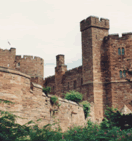
Peckforton Castle and the wall from which I jumped.
Somehow, I managed to hobble home and act
as if nothing had happened; we didn’t tell our
parents what we’d been up to, oth-erwise we’d
have been banned from going again. And as far as I
know, nothing ever came of the alarm we’d set
off. (Strangely enough, although my sprained ankles
recovered in due course, that crazy jump left a mark
that showed up in x-rays as a hairline crack 40 years
later, but it wasn’t a mark I regretted).
So, although we lived our separate lives, now and
then we’d do things together, but when I left
home and went to live with either Sheila or Glen,
I saw him only occasionally, and in these years we
both changed a lot. I had not been the most brilliant
student in school, but he was even less so, and while
I was always an avid reader, he showed no interest
in books.
I’ve mentioned that our dad had quite a collection
of books and would often read at night, and sometimes
in the daytime, in the privacy of his loft, when he
was not busy with his car or his tools, making something
or other (being self-employed, he would finish his
work by noon and then come home for lunch, to continue
later). His favorite authors ~ who consequently became
mine ~ were Jules Verne and H.G. Wells, and via their
tales, I accom-panied Captain Nemo 20,000 Leagues
Under the Sea, went to the Centre of the
Earth, to The Mysterious Island, and
so on; H.G. Wells took me back to the past and far
into the future on his Time Machine, where
I saw how humanity had diverged into two quite different
strains ~ the gentle, herbivorous and defense-less
Eloi, and the aggressive, cannibalistic Morlocks.
With Wells, too, I went through the War of the
Worlds, when Martians in-vaded Earth and practically
took over, until they were defeated not by us but
by Earth’s germs and bacteria against which
they had no immunity or defense. What fantastic tales
they were ~ and still are!
Then, I used to buy a publication known as Classics
Illustrated ~ well-known stories, classics
~ in comic-book form; they cost a shilling each back
then, and there were hundreds of them; I amassed quite
a collection, and thereby became somewhat ac-quainted
with the literature of many lands.
How George went on in Tattenhall school, which he
started soon after I did ~ I started late, the system
of going from primary-school to secondary was a recent
development ~ I really don’t know, as we were
in different classes, of course. He didn’t dis-like
school as I did, however, and was probably more resigned
to it and integrated than me. What I do remember was
that, after I’d left there and gone on to college,
during one holiday, he’d gone to stay at Glen’s
for a while ~ he would have been 14 or 15 at the time
~ and met a girl named Susan who lived nearby; she
was a bit younger than him, and just as precocious
or even mo-reso than he, and pretty soon, they were
having sex together and somehow got caught. Well,
he was reprimanded, and that was it as far as he was
concerned, but poor Susan was sent off to a reform-school
for wayward girls ~ such was the attitude of the authorities
towards juvenile sex 40 years ago ~ where she had
to stay, with occasional visits home, for 2 years!
George went straight from school to work, at the age
of 15 ~ no college for him ~ and our lives took quite
different tracks. Any-way, to return to Istanbul,
where I asked him to go home and leave me free of
the responsibility of having him with me: actu-ally,
although it wasn’t a nice thing to do, I had
not much choice, as he wouldn’t have enjoyed
the trip further east. Really, I should not have brought
him with me in the first place, but should have left
him at home to continue the life-style he was familiar
with ~ going to pubs with his friends ~ a lifestyle
which, although I’d worked in a bar, I didn’t
enjoy or feel part of, having seen it from the other
side of the fence, as it were, and considered it a
great waste of money.
During our stay in Istanbul, our dorm-room was shared
by a Turk (we were unwise, and should have known better),
and one day, while we were out, this guy took the
opportunity to ransack our bags, and we got back to
find him and my camera gone; it was probably a trick
he’d employed before. My impression of the Turks
did not improve over time; there was more to come.
Before we parted, George met some Danes and arranged
to go to Denmark with them before returning to England,
but they took advantage of his gullibility and cheated
him of his money.
And I’d met a French guy named Xavier Tonneau
who was heading to Afghanistan in order to buy hash
and smuggle it back to France; his plans were already
made, and I had no objection to them, so we agreed
to travel together. That must have been in November
’68, and it was already cold, so we took a train
as far as Erzerum in eastern Turkey, about 100 miles
from the bor-der with Iran, for which we got visas
before leaving Istanbul. We were joined by an English
guy who, for some reason, I called Ori. We got a compartment
almost to ourselves except for an elderly Turk by
the name of Ishmail, who spoke no English at all,
but who was friendly-enough anyway; he was going home
somewhere in the east, but not as far as us. The journey
was very long, and the train moved slowly; it took
two days and nights, I think. Now, Xavier had bought
some alabaster eggs in Istanbul, and loved them for
their smoothness and shape; he of-ten held and caressed
them. Because of this, I ~ who always had a knack
of coming up with nick-names for people ~ called him
‘Oeuf’ (the French for ‘egg’).
Well, one morning on our seemingly-interminable train-ride,
Oeuf, who’d been sleeping with his boots off,
discovered egg-yolk on his socks, and we couldn’t
imagine where it had come from ~ quite a coincidence,
Oeuf, and no-one else with egg on his socks! ~ until
later, the mystery was solved when Ishmael produced
an egg from somewhere and proceeded to suck it! We
laughed so much!
He got off in quite literally the middle of nowhere,
as there was no station or any other building in sight,
and as he was walking off and the train pulled slowly
away, we waved our farewells to him and sang a song
we’d made up with his name in it; he grinned
broadly as we left him behind on the steppes.
There was snow on the ground when we arrived in Erzerum,
and it was very cold. We found a hotel and settled
in for the night, having bought tickets for a bus
to Tabriz ~ the first big city over the border in
Iran ~ for the next day. Now, it is true that we smoked
dope in our room, and then Oeuf went to the toilet
and came back only after a long time, with blood streaming
from a cut on his head. “What happened?”
Ori and I both said, jumping up. He told us he’d
slipped on the toilet-floor, banged his head, and
must have lost consciousness. As he was bleeding quite
badly, I bandaged him up as best I could, and we had
to get him to a doctor, but it was already late at
night. Down in the lobby, people became excited and
accused us of having been smoking dope (we denied
it, as it was a serious offence, and we could have
been jailed) They refused to help us, so we went outside
to try to find a doctor, but this was futile. Oeuf
was quite groggy by this time from the effects of
the hash and the severe knock on his head, and blood
had seeped through his bandage. But, far from finding
a doctor, we were attacked on the street by some ruffians,
and had to fight them off in order to retreat to the
hotel. Anyway, we somehow made it through the night,
but I kept Oeuf awake and didn’t allow him to
sleep in case he went into con-cussion, in which case
we would have been in much deeper trouble. The hotel-people
regarded us with scowling faces as we checked out
to catch our bus.
We spent only long enough in Iran to get through that
land, where we had our first encounter with very strict
Islam, and where most women wore the long cover-alls
known as chadors, but sans the face-covering
with just a slit or some mesh for the eyes; we got
our visa for Afghanistan in the eastern city of Meshed.
Oeuf had recovered by this time, and kept us enter-tained
in the hotel room with the guitar he had with him;
he was really quite talented. Meshed is famous for
turquoise, and we’d been advised by other travelers
to buy some to sell elsewhere at a large profit, so
into a turquoise-factory we went, and while buy-ing
some small stones, a larger stone fell into my pocket
~ one of many things I regret. (Not being much of
a salesman, I was unable to sell any, and lost on
my investment).
We crossed the border to Herat and found
ourselves in a time-warp; our dope-smoking ~ and it
was not yet illegal in Afghani-stan ~ enhanced the
impression that it was straight out of the ‘Arabian
Nights’, and we wouldn’t have been
surprised to come across Sinbad the Sailor preparing
the merchandise for his next voyage, or Aladdin rubbing
his magic lamp, or Ali Baba mutter-ing ‘Open
Sesame’ so as not to forget the password to
the door to the treasure-cave he’d come across.
Afghan men wore tradi-tional baggy pants and long
shirts covered by embroidered waistcoats, huge turbans,
and shoes with turned-up toes; most had beards, and
some carried long-barreled muskets known as ‘jaziels’;
they were fierce people, loyal only to Islam and their
tribal leaders; mess with them and you wouldn’t
stand much chance, but otherwise, they’d leave
you alone, not friendly, not unfriendly. The women
were even more concealed than in Iran, with only hands
and feet visible under their burqas.
We stayed in Herat overnight and left next day to
Kandahar in the south; it took most of the
day, and because of the winter rains and snow, we
found it ~ like Herat ~ a sea of mud. First thing
we did was find a cheap hotel, and when I say cheap,
I mean about a dollar per day for a room with several
beds, the covers of which were none-too-clean, and
the sheets showing ‘fried-egg’ stains
of the nocturnal emissions of previous occu-pants.
There were no such things as attached bathrooms and
toilets, and indeed, no bathrooms as such at all;
Afghans seemed not to know of bathing or showering
except in rivers when weather permitted. As for toilets,
well, there was just a hole in the floor through which
you let your stuff go, and beside the hole a box of
stones to serve as toilet-paper, or maybe a pot of
water with which to wash yourself. Oh, they did have
toilet-paper in Afghanistan; I saw shops with great
amounts of it that had been donated by some aid-agency
~ World Relief, perhaps ~ but it was useless
to the Afghans, as they never used it for its intended
purpose, and probably didn’t know what it was
for, like the condoms I saw kids blowing up with bike-pumps
as balloons ~ also foreign aid!
Having found a place to stay and deposit our stuff,
we went to eat, and were amazed to see stacks of hash
in ¼ -kg slabs on the floor of the restaurant,
for sale at just $10 per kg. I saw in one place what
must have been hundreds of kilos of the stuff! We
were in dope-smokers’ heaven!
Someone came up to me and in his smattering of English,
said, “You know Mister Bob from Callipunya?
Ee my priend!”
Oeuf set about implementing his plan, and I joined
him. We went to a hash-dealer who someone had recommended,
bought a kg each, and told him we wanted it concealed
in a pair of shoes. “No problem,” he said
(he spoke some English, having dealt with crazies
before and no doubt understood their wants). For Oeuf,
he brought out some quite nice boots, proceeded to
open up the soles and pack the hash inside before
fixing the soles back into place; there was almost
½ kg in each, and they looked okay. And for
me, he produced a huge pair of ancient brogue shoes,
ripped back the soles and stuffed the hash inside,
then nailed the soles back on, leaving them round
and bulging, like balls; they looked and felt quite
ridiculous and would have passed no-one’s scrutiny.
I took them anyway, thinking, “What the heck!”
and we left Kandahar for Kabul, which was Oeuf’s
furthest point. Here, we parted, he hopefully to return
to France, and me to go on to India in my rock-n-roll
shoes. He had carried with him, all the way from home,
many packets of Gauloise and Gitane ciga-rettes which
he intended to offer to the Customs and Immigra-tion
officials as Xmas presents at the borders of Iran
and Tur-key, so they wouldn’t give him a hard
time, but I advised him against this saying it would
look suss and be regarded as a bribe. I wished him
well anyway, and we went our separate ways. Months
later, I got a letter from him, saying he’d
made it back home alright, and I breathed a sigh of
relief for him. I never heard from him again after
that.
For some time, I’d been passing bloody stools,
and never having had piles before, was quite worried,
so went to Kabul’s main hospital. A young doctor
examined me with a gloved finger, but didn’t
diagnose or prescribe anything for my ailment. I was
left in ignorance, but fortunately, it wasn’t
about something serious, and I didn’t bleed
to death.
In Kabul, I bumped into a guy I’d met earlier
that year in Israel ~ a red-haired Canadian named
Bruce, and we decided to travel together to Goa, as
we’d both made up our minds to go there for
the Christmas party we’d heard would be held
on the beach; Goa was already a hippie-mecca, along
with Benares in north-ern India and Kathmandu in Nepal.
Consequently, we got a bus which carried us through
the rugged Khyber Pass ~ which so many invaders before
us had used, including Alexander the Great and his
forces ~ through the lawless town of Landikotl, where
all kinds of guns were replicated using only very
basic tools, and to a high degree of accuracy, too
~ to the ancient city of Peshawar. What a pity we
greenhorns didn’t halt here longer in our headlong
rush than just to eat something and get a bus south,
but there are many things in life that we look back
on later ~ both done and undone ~ about which we say,
“What a pity”; that was just one.
In Lahore, again, we did nothing except get a permit
to cross the border into India; this wasn’t
a visa (we didn’t need one for India, or for
Pakistan; in those days, Commonwealth citizens could
go to Pakistan, India and Sri Lanka without
visas, and stay as long as they liked; it changed
in the mid-‘80’s, and became such a hassle
to get a visa for India, and to a lesser extent, for
Paki-stan, too), but a formality created by desk-babus,
and there was no way around it. Then, with our permits,
we set off to the border by local bus, where I rocked
and rolled across ~ and it’s quite a distance
between the two borders ~ in my bulging brogues, just
as I’d done across the Afghan-Pak border, quite
confident, and lucky enough to pass without let-or-hindrance.
The border-guards and officials had seen all kinds
of weird people flooding into India by then, and so
I didn’t stand out as in any way ab-normal;
it was the time of the hippies, or ‘freaks’
as they called themselves, not waiting for other people
to categorize them so.
I was in the land of my dreams at last! India had
called me from childhood, though I didn’t know
why, as there was no family-connection with it, and
as far as I was aware, none of my ances-tors on either
of my parents’ side had been there during the
time of the Raj or the East India Company. But there
was this inexpli-cable fascination with India. In
my mind, for years, had been an image ~ gleaned, no
doubt, from the myths and fantasies I used to read
in my younger years, that India was a place where
gems lay thickly on the beds of crystal-clear streams
and rivers like the Ganges, there for anyone to reach
in and take. How disillu-sioned I was soon to be!
Bruce and I caught an overnight train from Ferozpore
to Delhi, where we spent a couple of days having a
quick look around ~ though little of that remains
in my mind within easy recall now ~ before boarding
a Bombay-bound train. Now, we’d heard that foreigners
could ride the trains of India without tickets (as
did the sadhus, fakirs, or holy-men), and
not be bothered by the con-ductors, but this was soon
revealed to be a myth, because no sooner had the train
reached the outskirts of Delhi than the con-ductor
came along, and finding we didn’t have tickets,
uncere-moniously put us off the train when it next
stopped soon after, not at a station, but out in the
countryside (trains stop anywhere in India ~ sometimes
for long periods and for no apparent rea-son ~ and
not just at scheduled stops). With our tails between
our legs, so to speak, we hitched a ride back to Delhi,
and went through the procedure of applying for a reservation
on a train to Bombay, using the fraudulent International
Student Cards we’d bought in Kabul for
$1, but which, accepted without question, entitled
us to travel at half-fare on trains in India and Pakistan.
What scoundrels we were; but we were just doing what
so many others were doing, and saw nothing wrong with
it.
It was a journey of over 24 hours to Bombay, and during
it, I was to see for the first time king-sized cockroaches
running around the carriages; I’d never seen
such things before and didn’t know what they
were, but when told, I began to stamp on them when
they came within range.
Reaching Bombay, for the first time, too ~ there were
so many ‘first time’ sounds, sights, smells,
tastes and other experiences in India, and if it were
possible to tell of them all, this narrative would
never come to an end ~ I saw young coconuts, the kind
that you drink from a hole chopped in the top, lying
discarded on the streets, and didn’t know what
they were until I saw people drinking their juice,
as the only coconuts I’d seen until then were
the de-husked ones of fairgrounds and fruit-stalls
back home. There was so much to learn.
Well, after finding a hotel to stay for a few days,
we went out ex-ploring, and without meaning to go
there, soon found ourselves in the notorious Street
of the Cages, the red-light district where the whores
call out to prospective clients from inside barred
house-fronts. Strangely, this area had been set up
by the British during the Raj for the recreation of
their troops, and women and girls ~ some of them very
young and pretty ~ were procured from all over India
and Nepal, and even beyond. Needless to say, we didn’t
avail ourselves of the goods on offer, but I later
met a German guy who did, and who had to resort to
shots of penicillin to cure what he had picked up
there!
Another ‘first’ in Bombay: while walking
along near the port to book passage on the twice-weekly
steamer to Panaji, Goa, we were approached
by two heavily-made-up husky ~ what I in my naivete,
and Bruce, too, took to be ~ whores, and it was a
long minute or two before we realized they were transvestites;
I was so young and had lived such a sheltered life
until then, in spite of my travels, that I was innocent
of such things, and Bruce was even moreso. They knew
this, and made fun of us when they saw we weren’t
going to respond to their advances, and moved off.
(I later read a book called City of Joy about
Calcutta’s most-terrible slum-area, in which
it is said that there is a sort of sub-caste of such
transvestites and eunuchs, even until today; they
are bought from poor families at a very young age
and cas-trated, and later earn their living by dancing,
singing and per-forming ceremonies at weddings, funerals
and so on, and if they don’t get the considerable
sums they demand for these services, they become abusive
and curse people with profanities. They are looked
down on, but are otherwise tolerated and not beaten
up or killed as they probably would be in western
countries).
Our steamer-trip down the coast to Panaji took two
days and nights, and it was balmy enough to sleep
on deck, and enjoy-able but for the bedbugs that infested
the benches, and which would creep out, even in the
daytime, but moreso at night, to avail themselves
of any exposed flesh. This was my first en-counter
with these loathsome creatures, which varied from
pin-head to lentil-size, depending upon their age;
they smell horrible when squashed, and you’d
come across them all over India in those days, even
in the wooden-slatted benches in trains and post-offices,
but in later years were seldom seen; I don’t
under-stood why, but it was big a plus!
Disembarking at Panaji, we got a bus to Calangut,
the main ‘scene’ at Goa for hippies from
all over. Many people rented thatched cottages and
huts from the fisher-folk for a few dollars a month,
and filled them with their friends, or shared the
costs with others, like ourselves. I met and moved
in with a guy from Beirut by the name of Hussaid
el Jabri who looked like an Old Testament prophet,
as he wore a potato-sack with holes cut in it for
his head and arms, and was, of course ~ like a majority
of hippy-guys ~ bearded. I don’t know if he
was originally Muslim or Christian, but he was a nice
guy.
There were maybe 500 people at the Xmas party on the
beach, and the setting was idyllic, with the phosphorescent
sea on one side, and the full moon rising through
the coconut palms on the other. There was a lot of
dope-smoking going on; some people had taken LSD and
other stuff. Various musical instruments were being
played, and some food was shared around; some people
had got together to buy a pig, which was roasting
over an open fire. How long it all went on I don’t
know, as I fell into a drugged sleep on the sand,
and when I awoke, cold, damp and stiff, I found few
others around me, so I got up and went home.
Goa’s beaches were pristine, and go on for miles
and miles, which is why people were attracted there;
it was idyllic, espe-cially at the end and the beginning
of the year, when it wasn’t yet hot. We felt
free to do our own thing, and really, anything went.
India is a very conservative country, and soon, Indians
were coming from all over to see naked ~ and I mean
nude ~ hippies lying on the beach; sexually-repressed
men of all ages would come to ogle the girls, and
now and then, because it was news, the authorities
sent police to arrest a few people for inde-cent exposure,
but generally, we were left alone, and I regret to
say that many of us took advantage of it and abused
it. It’s hard to say what the Goans themselves
thought of it as many had benefitted, financially,
from this alien invasion, and must have been changed
by it all. One guy appeared in Calangute market wearing
nothing more than a torn-out front-pocket of his jeans
tied around his genitals! And although he might have
been an exception, it was not by much. Totally insensitive
and inconsid-erate of others, we were mad!
Drug-abuse had caused lots of people to freak out,
and their erratic behavior must have caused considerable
consternation; there were not a few cases of death
by overdose; some people were found dead on the beach.
Many people were into the ‘hipper-than-thou’
trip, playing mind-games with others, and there was
no shortage of cheats and thieves; the hippie ideals
of love, peace and sharing were not much in evidence;
it was already a sick scene. This is not to say there
were no good people there, of course, because there
were. And there were two kinds of drug-users: light
and heavy; by light, I mean those who smoked hash
and marijuana and perhaps took LSD occasionally, and
by heavy, people who had become junkies, injecting
heroin and such like. The two groups usually avoided
each other.
I’d met an English junkie on the boat from Bombay
who ap-peared destitute (as many junkies were), so
I paid for him a meal. In Goa, however, he ignored
me and didn’t speak even when we ran into each
other, until one day, with no place to stay, he asked
if he could stay at mine; I reluctantly agreed. His
behavior, however, was too bad, and one morning, I
heard a commotion outside, and went to see what it
was all about. The locals were upset ~ understandably
~ because this fellow, in-stead of using the toilet
like everyone else did, had gone and defecated on
the sand and hadn’t even bothered to cover it
up, just like a dog! I threw him out!
A note here on the toilet-system there: There were,
of course, no flush-toilets; the Goan-style consisted
of a palm-leaf-screened-in cement platform with a
slope at the back, down which fell your droppings,
which were eagerly devoured by the black, bristle-backed
pigs that very often were waiting to receive your
offerings. It was a bit off-putting at first, to hear
these ani-mals grunting away and obviously enjoying
themselves so close to one’s delicate parts!
Many Goans spoke Portuguese, as Goa had been under
Portu-gal for 500 years. Probably because Portugal
was one of their long-standing allies, the Brits hadn’t
taken over and absorbed it into their empire as they’d
done with the several tiny French en-claves in India.
In 1947, when the Raj finally ended and India
became independent, the federal government allowed
Goa to remain under Portugal until it felt brave enough
to liberate and incorporate it into India in 1963,
not long before it was discov-ered by the hippies.
Most people would go to the village post-office now
and then to check if they had mail at the Poste
Restante desk. Now, Poste Restante was a usually-free
service provided by most post-offices worldwide and
still is. People would write to their families and
friends and give as a return-address the Poste Restante
~ let’s say ~ in Bombay, India, and this was
enough for mail to reach them there. It was very convenient,
and I often used it ~ and occasionally still do ~
in various countries around the world when I had no
other address. However, I generally asked people to
use only aerograms when writing to me, in order for
their let-ters to have a better chance of reaching
me; aerograms may not contain anything, you see, and
so form no temptation to anyone who might otherwise
feel inclined to open envelopes in search of easy
money. I and countless others lost letters that way.
Later on, I was given a tip on how to foil the would-be
post-office thieves: Put your letter and whatever
else you want to send in-side the envelope and seal
down the flap, but before the gum has time to dry
lift the flap again, and if it’s a little torn
or crum-pled from doing so, all the better. Then,
apply some gum in sev-eral points along the flap ~
but not completely ~ and stick it down again, so that
it clearly appears to have been opened. Anyone looking
at it thereafter might conclude, ‘No point in
opening this one ~ someone beat me to it’!
Goa was a ‘wet state’ ~ that is, manufacture,
sale and consump-tion of alcohol was allowed, unlike
in some other states where prohibition was in force,
not that we cared much about alcohol as such, but
as foreigners, we were allowed ‘liquor-permits,’
is-sued free at Government of India tourist offices
in one’s name, which we could use to legally
take liquor from one state to an-other, and upon leaving
Goa to return to Bombay in Maharash-tra ~ a ‘dry
state’ ~ it was quite common for people, covered
by their liquor-permit, to take half-a-dozen bottles
or more of feni (cashew-liquor) with them to sell
there; it paid for the cost of the steamer, at least;
anything to make a little money, as most trav-elers
were not very wealthy, and what money they had with
them had to last as long as possible; remember, most
of us had come overland from Europe, hitch-hiking
or by bus or train, rather than jetting in, and lived
very frugally. Even the liquor-permits could be sold.
One day, in Panaji, I bought some cashew-fruits. I
knew what cashew-nuts were, but had never
seen the fruit before; I recog-nized them from the
nut-case at the bottom of the fruit. Not knowing that
the nuts had to be got at by roasting the cases over
a fire, when small flames shoot out, I bit into the
shell, only to get my lips burnt by strong acid therein
~ similar, apparently, to that of poison-oak or poison-ivy.
I ran to a nearby soft-drinks stand and quickly drank
several bottles to assuage the burning sensation;
another lesson learned: never bite the shell of a
cashew-nut. The fruit itself is very strange: pear-shaped,
soft, and full of juice, but when eaten, it dries
your mouth out; the proper way to eat it ~ I later
learned from Vietnamese when I was in the Philippines
~ is to sprinkle salt on it, and it thereby becomes
sweet; this works with other sour fruit, as well.
The hash from my shoes was either smoked, given away
or sold in small amounts. Hash in India cost more
than in Afghanistan or Pakistan, and there was definitely
a market for it in Goa.
After some weeks in Calangute, I headed out with Bruce
again, and a friendly, easy-going guy from Sydney
named Laurie, back to Bombay, where we sold our liquor.
Laurie had been in India longer than us, and so acted
as a sort of guide. He introduced us to the gastronomic
pleasure of the South Indian dish known as dosa, which
became and remains maybe my favorite food; it is a
kind of pancake or crepe made of rice-flour, served
with a thin spicy sauce and coconut chutney; I often
think of Laurie when I eat dosa). From Bombay, we
went north to Agra, where a visit to the Taj Mahal
was a must, and in fact, the main reason for going
there, and though I’ve been back several times
since, I’ll never forget that time.
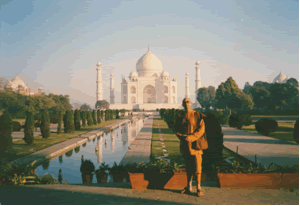
The Incomparable Taj Mahal, Agra
The gleaming domes and minarets are visible
from afar, but awe and suspense mounted as we got
nearer to the vast walled compound. Entering the gate
~ itself a marvel ~ I gasped, for there, beyond the
symmetry of the reflecting pool and geometri-cal gardens,
shimmered the pearly vision we’d come to see.
It seemed so near that I felt I could reach out and
touch the smooth white marble, but the tiny figures
up against it reminded me that it was actually still
some distance away.
Walking reverently down the path, we reached the terrace
and removed our sandals; the marble was so cool; did
it not, like other stone, absorb the sun’s heat?
With heightened rapture, we approached the shrine,
its walls inset with arabesques and floral motifs
done in gem-stones ~ agate, jade, turquoise, lapis
lazuli, carnelian ~ 28 kinds all told. Through the
massive doorway we passed into the shaded interior
of the tomb, where two magnifi-cent but empty sarcophagi
stand; the bones of Shah Jahan, and those of his beloved
wife, Mumtaz, in memory of whom he had raised
the mausoleum, lie in exact replicas of these in a
crypt di-rectly below; his wife’s grave occupies
central place, while his is alongside hers. The dome
is so immense and lofty that the slightest sound causes
an echo. There were few tourists at the time, so we
were able to enjoy this wonder in peace (it is differ-ent
now, sad to say). I recall the thrill I felt to play
a flute inside; the silvery sounds reverberated and
lingered on the still, cool air!
There were many birds and animals in the Taj gardens.
Green parrots screeched their zig-zag way between
the trees, halting abruptly against trunk or limb;
ubiquitous crows cawed hungrily, eyes keen for food-scraps;
palm-squirrels scampered hither and thither, tails
a-twitch; the occasional mongoose could also be seen,
alert for snakes. Soaring on high, vultures effortlessly
rose on the thermal currents, scanning the earth beneath
for signs of death; on land, their ungainly bodies
are repulsive, but in the air they are graceful masters
of flight; the turn of a feather or twist of a wing-tip
sends them spiraling higher, or plunging swiftly;
it was fascinating to watch them until they were just
tiny dots against the boundless blue. Nor were they
alone in their airy realm; it was shared by birds
of prey: eagles, hawks and kites.
Security wasn’t as tight as it later became,
so we remained in-side the gardens after closing-time,
though we knew it was for-bidden (nice to break the
law sometimes, isn’t it? We did no harm). Spreading
our sleeping-kit on the lawns, we settled down to
watch, and within the space of twelve hours, we were
privi-leged to see the Taj change in different lights:
sunset, rain, full-moon, and sunrise ~ a pleasure
few can have had.
While standing on the platform of the Taj, overlooking
the muddy and polluted River Jumna that flows sluggishly
behind it, we saw a human corpse come floating slowly
past, with a vulture perched on it, pecking and tearing
away. It was a fascinating if macabre sight, but nothing
out of the ordinary in India, where life is lived
in the raw. We’d already seen shacks on the
streets of Bombay ~ if they could be called shacks:
old tarpaulins, card-board boxes, jute sacks and odds
and ends of various other ma-terials thrown up against
walls and fences to screen and shelter the occupants
from view and weather, wherein they lived their lives,
made love, gave birth, raised their families, and
faced death; such was home to many people who’d
been drawn to the city from villages hoping for a
better life than they’d left behind.
Laurie had been to Agra before, so was again our guide,
taking us to places like the immense Red Fort,
which had been built by Emperor Akbar in
the 16th century, and the tomb of Itimad-ud-Daulah
~ father of Emperor Jehangir’s powerful,
influential and ruthless wife, Nur Jehan ~ the rich
inlays of semi-precious stones of which inspired the
building of the Taj years later.
Then on to Delhi, where we split up; Bruce went to
Benares, to learn to play the sitar before returning
to Canada; I forget where Laurie went, and never saw
either of them again. I went back to Pakistan, with
the idea of buying more hash to take back to sell
in Goa. I crossed the border to Lahore, but thinking
it would not be easy to find the stuff there, I took
the train to Quetta, a long ride through
the desert and the famed Baluchistan It was so cold
when I got there, and I slept on a table in the station
waiting-room with just a thin cotton sheet to cover
me (my old sleeping bag had long gone, sold for next-to-nothing
to someone on the boat from Haifa to Istanbul, in
an attempt to lighten my load), and the next day ventured
forth in search of hash. How vulnerable I was hardly
bears thinking of now, as Quetta is the capital of
Baluchistan, a wild province where tribal
law holds. Anyway, unable to find what I wanted, I
returned to Lahore and soon got 3 kgs for $30 with
no trouble at all. In my hotel-room, I carefully wrapped
it in strong plastic, sealed it with scotch-tape and,
having acquired the necessary road-permit, set out
for the border with it hanging down my back in three
pack-ages, concealed ~ I hopefully thought ~ by a
voluminous shirt, but probably looking like the Hunchback
of Notre Dame. Once again, my luck held, and I passed
undetected, and with a sense of relief, was soon on
the long journey back to Goa, my pack-ages now in
my bag. I stopped in Bombay again, and before boarding
the steamer, bought three carved wooden elephants,
some red velvet, sticks of sealing-wax, and a chisel.
Back in Calangute, I entrusted some of my haul to
an old Eng-lish hippie to sell for me, but he ripped
me off; my mistake, but there was little I could do
about it. I went into Panaji one day and found a machine-shop
where I had 3-cm holes drilled deep into my elephants’
backs; the guys who did it suspected that I in-tended
to smuggle gold inside; if only they’d known!
Back at my beach-house ~ and this time, I’d
taken over Hussaid’s place ~ with the chisel,
I further hollowed out the elephants ~ which were
about 5 inches tall, and 3 inches wide ~ until there
was a size-able cavity, and then tightly packed the
hash inside, rammed it down, and melted sealing-wax
over it to make it as air-tight as possible to contain
the strong smell; and over this, glued a piece of
the velvet to appear as a traditional ‘howdah-cloth’.
Satisfied that my handiwork looked quite professional,
I mailed 2 of them to my home-address and the third
to Jeanne’s home in Amster-dam, and they were
all awaiting me when I got back from India. Nor did
I have any qualms about my drug-dealing and smug-gling,
telling myself it was only a ‘soft’ drug
that didn’t cause ad-diction ~ so I had heard
and believed ~ unlike ‘hard’ drugs such
as heroin or cocaine; my conscience had been dulled
by the lifestyle I’d been living and the company
I’d kept. Much later, I realized that addiction
is more in the mind than the body, and we may become
addicted to practically anything; indeed, because
of our proclivity to addiction ~ grasping and becoming
attached to things ~ most of us are addicted to something
or other, and unless we understand the mechanisms
of the mind, there won’t be much we can do about
it.
I remained in Goa some more weeks until I thought
it time to head back to Europe; before doing so, I
hollowed out a tablet of Lifebuoy (strong-smelling
carbolic soap), inserted a piece of hash in it, then
dropped it in the sand to make it look as if it had
been used; I intended to carry this back to England
with me. Then, bidding farewell to the friends I was
leaving, once again boarded the steamer for Bombay,
where ~ alone, this time ~ I caught a train at the
Raj-era Victoria Terminal to Benares; I couldn’t
leave India without seeing this ancient and holiest-of-holy
Hindu city on a bend of the Ganges, where many ‘firsts’
awaited me. I passed through the crowded streets to
the ghats ~ banks of steps leading down to the river
~ where I saw people worshipping, bathing in the filthy
water, and even drinking it, blissfully engrossed
in their activities; under palm-leaf parasols, Brahmin
priests sat cross-legged, chanting mantras and per-forming
pujas for those willing to pay their fees; beggars
and lepers missing fingers, toes and sometimes noses,
mingled with the pious, asking alms and receiving
small coins, as means of making merit, and what better
place to do this? Elderly and sick people come from
all over India to Benares, hoping to spend their remaining
time here, as this is one of several thirtas or fords,
where it is easy to cross from this world to heaven;
it is considered that to die in this holy place is
a great blessing. Corpses, too, are brought here from
far and wide, to be cre-mated at the Burning Ghats;
there are always processions wending through the narrow
streets and lanes leading to these ghats, with shrouded
bodies carried high on stretchers; coffins are not
used. I followed people through the maze of lanes
and alleys to the place of fire and smoke and odor
of burning flesh, where, day and night, cremations
are always going on.
Standing aside, I watched in stunned silence. The
people in charge of the pyres are so used to their
grisly tasks that they perform them nonchalantly,
raking the still-smoking ash of one fire into the
river a few feet away in order to stack up the wood
for the next; of a particularly low sub-caste known
as Doms, these men are looked down upon by higher-borns,
as handling the dead is defiling work; but, knowing
their work indispensible, they charge what they like,
and many of them are very wealthy, especially their
mafia-like godfathers.
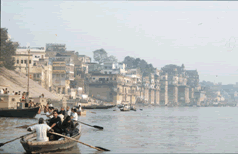
Benares (Varanasi) on the River Ganges
Watching the cremations, I stared in horror
as a leg of one corpse suddenly bent at the knee,
and thought, “Damn, it’s still alive!”
but it was only the tendons contracting with
the heat. Sadhus crouched among the ashes of the dead
~ ash-smeared, emaciated, naked except for brief loincloths,
long hair matted, foreheads bearing marks denoting
their preferred sect of Shivaism or Vishnuism
~ contemplating the impermanence of life and the inevitability
of death. Such sadhus were common sights in those
days, many of them fakes and beggars who took up the
lifestyle for an easy living, but some genuine and
impres-sive; it was said there were about 9 million
of them; over the years, however, I saw fewer and
fewer of them and wondered what had happened, whether
they had retreated to the moun-tains or forests, given
up and ‘returned to the world,’ or simply
died. I also noticed a change in Indian culture ~
and not for the better, either; many Indians have
lost their faith and become more materialistic and
less spiritual, especially in the cities and towns,
and this is glaringly evident in the great number
of so-called ‘dowry-deaths’. Most Indians,
however, don’t have the opportunity to indulge
their desires that people in the West do, but that
doesn’t mean the desire isn’t there. Of
course, there are still refined and spiritual Indians,
but the common Western belief about India being a
very spiritual land is just a myth. Religious superstition
is common, but that is so everywhere, is it not?
“As India’s own statistics show, a ‘dowry
death’ occurs every 100 minutes, when in-laws
cause the death of a new bride if they decide she
has not brought a sufficiently large dowry. This is
often described as a ‘kitchen’ death,
with the unlikely story that kerosene, the most common
fuel used for cooking, some-how splashed onto the
daughter-in-law and burned her to death before anyone
could save her. A consequence of this is that every
couple wants to have a male child.” (From “Culture
Smart! India”). Few of these murderers
are brought to justice and con-victed, and the husbands
remain free to marry again and get another dowry.
The saddest thing about these awful crimes, and the
hardest to understand, is that the mother-in-laws
~ who are probably the real culprits, having instigated
their sons to do the dreadful deeds ~ have been brides
themselves, so should know how it is to be in that
sad, unenviable position and sympathize with their
daughter-in-laws. It is often women themselves, therefore,
who oppose and retard the lawful rights of women as
a whole, when they should be in the front line! They
betray their gender.
The greater value placed upon males over females,
has caused the high abortion-rates of female fetuses
and rampant female in-fanticide, with the consequence
being that there are 35 million fewer females than
males in this nation. |