So Many Roads ~ SOUTH-EAST ASIA
"The first key to wisdom
is assiduous and frequent questioning ... For by doubting,
we come to inquiry, and by inquiry, we arrive at the
truth."
~ Pierre Abelard, French philosopher,
1079-1142 ~
After
two months of this, our spell at the army-base came
to an end and, my finances bolstered somewhat, I was
ready to move on, so said goodbye to Jo-Jo and Chris
and flew out to Portu-guese Timor, a desperately-poor
place, where I couldn’t see how people survived,
but somehow they did. I spent a few days in a place
on the beach at Dili that the authorities
had set aside for travelers, then boarded an old prop-job
Dakota for Kupang in Indonesian Timor, on
the other end of the island, where I had my first
taste of Indonesian cuisine, and liked it; there are
plenty of vegetarian dishes for people like me (and
after my last trip in India, I had finally become
committed).
Now, Kupang ~ of Captain Bligh of The Bounty
fame ~ is at the eastern end of the Indonesian archipelago,
and we had to take whatever form of transport we could
get from there, and after some inquiries, those of
us who were going ~ half-a-dozen or so ~ were able
to get passage on a naval cutter that was going to
Lombok. It was a pleasant-enough and relaxing
trip of two days. We had to sleep on deck, but this
wasn’t a problem, as it was warm, even at night,
and steaming into the lagoons of Flores and Ende
in the early morning, with volcanoes overshadowing
the harbors and flying-fish and dolphins in the clear
placid water around us, were memorable experiences.
Food on board wasn’t very appetizing, but I
guess you can’t have everything for long.
Disembarking at unspoiled Lombok island,
we crossed to the other side by bus, and got a ferry
to Bali several hours away. Bali at that side is dominated
by the still-active ~ and at times cataclysmically
so ~ Gunung Agung volcano, but at this time
it was quiet. Again, we crossed the island by bus,
through the palm-groves and meticulously-terraced
hillsides, to reach the capital, Denpasar.
There, I found a hotel for a few days, and hung out
at Kuta to watch the mesmerizing dances that
were staged for the tourists; I was fascinated in
particular by the Kris Dance, in which the
entranced performers staggered and fell around with
krisses (wavy daggers believed to have magical properties)
pressed against various parts of their anatomies,
in-cluding their faces, without sustaining hurt ~
very convincing!
With a Sydney guy named Mal who I’d met earlier
in Dili, I took off on a trek into the interior, through
the artists’ village of Ubud and up into the
mountains to Kintamani, from where we de-scended
to the lake at the foot of Gunung Batur,
another active volcano. Here, there are hot springs
to soak in, an always-relaxing experience. Climbing
back to Kintamani on the ridge, we then returned to
Denpasar via Singharaja in the north. During our time
in Bali, we sampled various kinds of fruit that I’d
never seen before, including rambutan and
salak ~ pear-shaped and rather dry and astringent,
with a skin like that of a snake, which was easy to
peel off; there was also the rose-apple or jambu,
from the kind of tree that Prince Siddhartha was said
to have sat under as a child and had his first taste
of enlightenment upon becoming aware of the suffering
of life around him.
From Bali, we crossed to Java by ferry, on which we
met some-one named Soeharso, who invited
us to stay with him in a hill-town named Malang, not
too far away. We accepted his offer and on the way,
at a place called Banjuwangi, he pointed
out the site of a mass-grave of many thousands of
people killed during the anti-communist fury of 1965;
I was shocked, unable to visu-alize this. We were
treated kindly at his home, and it was there that
I had my last-ever beer, out in a boat on a lake where
our friend had taken us; that was in August 1971.
The next day, we hitch-hiked to Jogjakarta
where we went to stay with Soeharso’s younger
brother, Semsul, who was living with some
fellow-students near Gajah Mada University.
They were a bit surprised when we turned up, as they
were not expecting, but welcomed us anyway when we
presented Soeharso’s letter of introduction,
and gave us one of their rooms. They also lent us
a motorbike on which to visit Borobudur some
30 miles outside of town. This stupendous Buddhist
monument in the form of a mandala ~ a stylized
representation of the cosmos as conceived by Buddhists
and Hindus ~ was built almost a thousand years ago
when Java was Buddhist-Hindu, but covered and concealed
by volcanic ash from an eruption some centuries ago,
and thus spared desecration at Muslim hands, until
~ surprisingly enough ~ it was discovered and uncovered
by the British during their brief control of Indonesia
in the early 19th century.
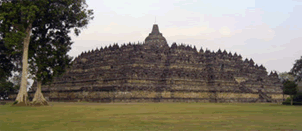
Borobudur Stupa, Central Java
We spent some time there examining the sculpted
walls of the various tiers that lead upwards to the
culminating great stupa on the summit ~ so long, in
fact, that our student friends became worried that
we’d either got lost or made off with their
bike, and came to look for us; they found us halfway
back at a restaurant where we’d stopped to eat.
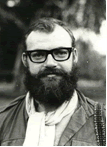
Java, 1971
The next stop along our route was Semarang,
and we got down from our ride in the middle of town
where great crowds were awaiting the Independence
Day procession; it was 17th of August. Well, we caused
quite a stir ourselves; maybe people took us as part
of the procession or even the highlight of it, because
hundreds of them followed us as we made our way out
of town to Sam Poh Kong, a large Chinese
temple built centuries earlier in honor of the famous
15th century Admiral Cheng Ho, who was both
a Muslim and a eunuch, and who apparently stopped
at this port-city during his several great voyages.
We requested permission to stay overnight there and
were allowed to; our en-tourage gradually dispersed.
Next morning ~ my 25th birthday, which is how I remembered
the date ~ we returned to the town for a look around,
and somehow met the chairman of a local Buddhist organization,
Pak Sadono, who, learning of my interest
in Buddhism and intention to be-come a monk, invited
us to stay in his home for a few days. He was very
kind, serving us different kinds of Indonesian food
every day. He also gave me letters of introduction
to several other Buddhist Societies and temples on
my way.
One day, while in Semarang, we went to Watu-Gong,
a Buddhist temple on a hill outside the town, and
walking back ~ it was a long way and we were tired
~ we decided to get a cycle-rickshaw, but I had an
idea, and said to one of the drivers, “You sit,
I ride; no money; okay?” He agreed, and Mal
got in with the driver in front, while I got on the
saddle behind. Well, it was fun, with some of the
driver’s friends riding alongside us (he was
so proud!), until we came to a crossroads, and the
lights were red, and I didn’t know how to stop
the thing; I pulled on the brake-lever when I should
have pushed it, and we were on the verge of going
over the lights when the driver jumped down and pushed
the brake, stopping us just in time! We did this again
another day, when I was confident of being able to
pull up ~ or push up!
Mal and I split up in Semarang, and with Pak Sadono’s
letters, I went from one place to another in Java
and Sumatra, experiencing much hospitality and kindness.
One day, outside Bandung, I met someone who
invited me to stay with him for a few days, and during
my time there, he and some other friends took me up
a hill nearby, where I had my second transcendental
experience, although my companions were unaware of
it; again, the I disap-peared, and was replaced by
a feeling of great love and joy. It cannot have lasted
long because we soon started to descend and return
home, but it was another treasure along my way.
I spent some time in Bandung and Bogor, then
passed through Jakarta, not wanting to stay and having
no letter to anyone there. From the western tip of
Java, I got a ferry to South Suma-tra, and traveled
up through that huge jungle-clad island. Again stopping
in various places, I got to Medan, and went to stay
in a temple there ~ Vihara Borobudur, named
after the monument in Java. There, I met another beautiful
person: an Indian Buddhist by the name of Kumarasami,
who took me, a waif and stray, un-der his wing during
the few days I spent there, making me feel like one
of his sons. I recall him speaking to me of the love
that develops as one follows the Path; he himself
manifested it in abundance, and I have since felt
it at times and know what a wonderful thing it is,
but ~ like humility ~ it cannot be practiced; it must
come, as a result of understanding or seeing things
clearly.
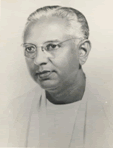
Mr. Kumarasami
Before I left to go to Malaysia, he also
gave me letters of intro-duction to temples in Penang
and Kuala Lumpur, but sadly, these letters
were not received in the same spirit as they were
given to me, as I will shortly explain.
Crossing the Straits of Malacca from Medan to Penang,
I had to wait for the Malaysian Customs and Immigration
officials to board the ferry and do their duty. I
got talking to one of them, and when he learned I
was a Buddhist, and had a letter to a Sri Lankan temple,
hoping to be allowed to stay there, he said I could
stay at a meditation-center, where he was a member;
his name was Amigo ~ his nickname; his real
name was Oon Teik Leng ~ and he gave me the
address of the meditation-centre. I told him I would
check it out.
Disembarking, I made my way to Mahindarama,
the Sri Lankan temple, and presented my letter to
one of the monks there, Ven. Pemaratana.
I could see from his expression that he wasn’t
very impressed with my appearance ~ some of these
monks have a way of looking down their noses without
saying anything, but which makes it quite clear what
they’re thinking ~ as I was wear-ing shorts,
and had a beard. He didn’t say anything, but
went off and didn’t come back, leaving me sitting
alone for a long time. “If they won’t
let me to stay,” I thought, “I’ll
have to find somewhere else.” Just then, he
reappeared, and I asked if I’d be allowed to
stay, as had been requested in the letter. Only then
did he say, “Well, the chief monk said you can
stay for a few days, but at the weekend, we’re
having a festival, so you’ll have to find some-where
else by then.” I thanked him and he led me to
a room at the back, where I bathed and put on a suit
of white Indian clothes that had been made specially
for me by Mr. Kumarasami as a parting gift, then went
out to the shrine-hall to do some chanting, such as
I had learned while staying in temples in Java and
Sumatra. Now this caused a noticeably different impression,
because in Theravada temples, only people who are
in retreat and observing what is known as ‘Eight
Precepts’ wear white. Well, I didn’t
know about this then, but was just wearing my gift-clothes
for the first time, unaware of their significance;
having been so long in India, I thought they were
just normal. The cool-ness the monks had shown towards
me before was less cool.
Next morning after breakfast, I went in search of
the meditation-centre, and found it without difficulty,
not far away. It was run by a Thai monk who spoke
no English at all. Some people there were able to
translate for me, by speaking Hokkien Chinese
to him, which he understood somewhat, having been
there some years already. Through them, then, I told
him that I’d like to learn to meditate, and
that if I could stay there, I could earn my keep,
as it were, by teaching English to anyone. Without
hesitation, he replied: “Yes, you are welcome
to stay here, and there are some Thai students who
would be glad of some help with their Eng-lish.”
The accommodation for me wouldn’t be very comfortable,
upstairs in a shed used for building-materials, but
I told them it would be fine. Delighted that I’d
found a place so easily, I told the monk I would come
back very soon.
Returning to Mahindrama, I told the monks I would
be going to stay at the Meditation Centre ~ Malaysian
Buddhist Meditation Center, known by its acronym,
MBMC ~ but they said, “Oh, don’t
go yet; we’d like you to stay for the festival
on Sunday, after which you may go.” I was quite
surprised by this about-turn, but thanked them and
agreed to stay. Sunday came, and so did the people
~ great crowds of them, as this was an important cere-mony
to offer robes and other requisites to monks at the
end of the annual 3-months Rains Retreat, more of
a tradition that has largely lost its meaning than
anything. And people believe ~ be-cause that’s
what they’ve been taught ~ that offerings made
at this time will bring them great merit, and so the
monks are loaded with things far in excess of what
they really need or can use. Well, understanding nothing
of this, and being the only European among all the
Asians (mainly Chinese, with some Sri Lankans and
a few Indians), I felt rather spare there, and did
whatever I was told to do, like a dummy. Then it was
time for lunch, with the monks being served first,
very respectfully, and with lots of bows and salutations,
by the devotees, who had brought food in great amounts.
I was standing there bewildered until summoned by
Ven. Pemaratana, and told to sit at his table, which
I did, of course, still not knowing the Theravada
custom of monks always eating apart from lay-people.
Now, why he waived this custom for me, I really don’t
know, but maybe it was because of the white clothes
I was again wearing. It must have been conspicuous,
however, but no-one said anything, either at the time
or afterwards, so I just sat there and ate. Most of
the dishes were of meat or fish, but a few were vegetarian,
and there were plenty of cakes and fruit, so I was
able to eat my fill.
The ceremony over, the people dispersed, leaving the
temple quiet again. The next morning, I was packed
and ready to leave, when some of the monks presented
me with things, both useful ~ like an umbrella, and
they had enough of those to stock a shop! ~ and useless,
like a peacock-feather fan. I thanked them, and went
off to the MBMC. It was only some time later that
I learned there was a kind of rivalry between Mahindarama
and MBMB, but that, I was to find out later still,
was not uncommon, and in fact, is quite the norm.
In MBMC, I learned how to meditate ~ the so-called
‘Burmese method of Vipassana’,
watching the abdomen rise-and-fall with the breath.
The teacher ~ Phra Khru (his rank, meaning,
‘Venerable Guru’) Dhammabarnchanvud,
was calm and quiet and had a nice demeanor, but didn’t
give much instruction; he just ex-pected his students
to get on with it, and if anyone had any questions
that some of the older ones might answer, that generally
sufficed, but in other cases, people might approach
him through a translator who spoke Thai, as his Hokkien
wasn’t that good, either. We addressed him as
‘Luang Pau,’ which is a Thai
honorific meaning something like, ‘Reverend
Father.’
It wasn’t long before I met Amigo there, and
he introduced me to his wife and two teenaged sons;
these boys, with plenty of time to themselves during
school holidays, showed me around a bit, and it was
from them that I learned how to use chopsticks while
eating a well-known Penang dish, hot and spicy laksa.
In the temple, meanwhile, I spent time reading to
a couple of Thai students, and getting them to read
to me; in this way, I helped them improve their English
a little. Other time, I spent meditating, sitting,
walking and standing, mindfully observing my bodily
sensations and watching my mind. This was not at all
easy at first, and often, when I sat down, I’d
fall asleep within a few minutes. I persisted, however,
and struggled with my thoughts for at least 20 minutes
before they would calm down enough to allow me to
continue, until I could sit for an hour. My posture
also gradually improved; at first, my knees would
stick up, as many Westerners’ knees do, and
later, I could sit in the half-lotus position but
with the right knee still sticking up, then gradually,
over another period of some days, that knee would
get lower and lower until it was resting comfortably
on the floor, and later still, I could manage the
full-lotus. Of course, I needed the support of a firm
cushion for this, otherwise it was hard to maintain
an upright posture for long without tending to slouch;
the cushion saves the expenditure of a lot of energy.
I was befriended by a young boy named Teoh Eng Soon,
who I soon began to call ‘Ashok.’ He used
to come to the temple al-most every day, and became
my confidante.
I immersed myself in Theravada Buddhism, and the Thai
form of it, at that. I read various books, attended
talks, and, knowing lit-tle, had ample space to be
filled with terms, concepts and ideas; I was eager,
like many a newcomer, and mistook such for real knowledge,
thinking that because I knew the words, I also knew
what they represented, a common, all-too-common,
mistake. I saw how people there intellectualized
and split hairs over silly things, clearly thinking
they were getting somewhere; they re-fused to use
the word 'reincarnation' because ~ they said ~ it
was a Hindu concept, as it implied the 'passing-over'
of an im-mortal soul from one body to another, which
Buddhism denies; their preferred word was 'rebirth'.
But just an iota of insight would have shown them
that, according to the Buddhist concept, this is also
incorrect, for nothing is 'reborn' ('re' = again,
so born-again). How, then, is the word 'rebirth' more
appropriate than 're-incarnation'? Life is a process,
a movement, like the sea. The rise and fall of the
waves is caused by a current of energy pass-ing through
the water; there are no waves apart from the water,
and there is nothing static or permanent that passes
through the waves, from one to another. So, although
Buddhists, for conven-ience, use the term 'rebirth,'
nothing is actually 'reborn’, as noth-ing in
our mind-body remains the same for two consecutive
moments even while we are alive; how much moreso when
we are dead? Of course, I didn’t know this at
the time.
I met someone there who spoke to me at some length
about the endless suffering of Samsara, and in my
naivete and beginner’s willingness to listen,
I took him to be an authority, overlooking or disregarding
his arrogance and conviction of being enlightened;
he’d read a lot, and had a group of sycophantic
followers, known as ‘The Subha Group’
(‘Subha’ is Pali for ‘Beautiful’
or ‘Good’), which he’d inherited
from his late uncle. I became scared, think-ing that
I’d had enough suffering in this life already,
and didn’t want it to go on and on forever,
so I went to Luang Pau and asked him to put me on
a meditation-course, imagining that I might become
enlightened during it; just see how naïve I was!
Well, he put me on a 2-weeks’ course, of about
17 hours’ medi-tation per day ~ one hour sitting,
followed by one hour standing, and one hour walking.
Meals were eaten extremely slowly (and in silence,
of course); bathing too, was done in very slow-motion.
The purpose of it all was to enable me to observe
more of the many movements involved in each action,
and to watch the mind while doing so, too; it was
not a matter of doing any-thing different or special,
but just to observe what is there, all the time. I
was allowed one hour for reading per day.
It was hard-going ~ not to get up early, as I’ve
always been an early-riser, but hard to discipline
myself to the schedule. I’d start out by chanting
for a while, followed by sitting; I made it through
the first hour alright, and then began walking, but
so slowly that it would take an hour to make one circuit
of the shrine-hall measuring maybe 15 meters on each
side. That wasn’t so bad, but then I began the
standing. It is said that the Buddha stood in one
spot, unmoving, for a whole week after His enlightenment,
gazing in gratitude at the tree under which he had
sheltered, but really, I can’t comprehend that,
because as I went on, just an hour resulted in pain
such as I had never known before, and when that hour
was up, I had to hold onto a pillar or door-post and
slowly lower myself to the floor! The sequence would
then be repeated.
Now, one afternoon, while reading a book by ~ strangely
enough, Christmas Humphries, again ~ I had that
experience, and ‘disappeared,’ for
the third time! It lasted about 30 minutes, and so,
maybe I’d not been so naïve after all,
as it was certainly an enlightenment experience, and
one which could not be pro-duced or brought about.
I did not try to tell anyone about it, be-cause even
though people there had been kind enough to me, I
didn’t feel sufficiently at ease with them to
confide about such things, thinking they might not
understand or might even deride them. And, because
of the language-barrier, to talk with Luang Pau was
not an option; therefore, I kept it to myself. Looking
back on it now, I did the right thing; they wouldn’t
have understood; their minds were already fixed.
While in MBMC, I met some other ‘outsiders’.
First, there was an American named Bobby, who wandered
in with her 7-year-old son, Sean. They’d been
traveling around the world for several years already,
Bobby teaching English where she could, to sup-port
them both. They were staying nearby, and came in,
at-tracted to Buddhism and meditation. We became friends
and were to meet again later in Bangkok. Then there
was Ray Seibel, who was with the RAAF ~ Royal Australian
Air Force ~ at its Butterworth base, on the mainland.
He lived with his wife, Judith, and their two children,
in Penang, and sometimes visited the temple with another
friend, Dorothy Brimacombe. They in-vited me to stay
with them in their home once or twice.
Now and then, a friend of Laung Pau’s came to
visit, a Thai-Chinese monk who stayed in a cave-temple
in Ipoh, a town 100 miles to the south. I came to
know him as Reverend Tong, and he asked me to visit
him sometime, saying there was an English monk staying
with him. I accepted his offer, curious to meet the
Brit monk, and found his cave quite comfortable, the
floor having been cemented and electricity installed.
A lady from a nearby village came to cook for the
three monks there, including Lodro Thaye,
the Brit, who was a follower of Tibetan Buddhism,
spe-cifically, the Karma Kagyu (otherwise
known as ‘The Red-Hat’ School because
of the red hats they wear during their ceremo-nies,
as distinct from the Gelugpas or ‘Yellow
Hats’). As a child, he’d been stricken
with rickets, leaving him with short legs. But he
was a friendly-enough fellow and I got on alright
with him.
I soon fell into a routine, rising early, and after
my morning chanting and meditation, swept out the
temple, cleaned the al-tar, removed the old incense-sticks
and offered fresh flowers from the garden. Because
of this, Reverend Tong liked me, but not so the other
monk there ~ a local Chinese who’d become a
monk in his old age. He clearly disliked me (maybe
jealous of the abbot’s approval of me), and
made life hard for me, criticiz-ing and scolding me,
and bad-mouthing me to others, some of whom believed
he had some psychic powers that he wouldn’t
hesitate to use against anyone who displeased him.
Whether this was so or not, I can’t say, but
I was quite miserable for a while, and I considered
leaving and going elsewhere. I could have become angry
and scolded him back, but remembering what the Buddha
had said about hate not being overcome by hate, and
what I’d learned in primary-school about two
wrongs not making a right, I didn’t do so. Instead,
one morning, as I was putting fresh flowers on the
altar, I thought of another way, the way of judo,
which enables one to overcome another by using his
strength against him, instead of one's own. So I prepared
an extra dish of flowers, took it to his room, and
knocked on the door. When he opened it, I offered
the flowers to him, without saying anything, and he
accepted them, also without a word. He was never angry
with me after that, and later, when I left that temple
to go elsewhere, he gave me RM50! If I had become
an-gry and scolded him, he would have hated me more.
But be-cause I knew there are other ways, I was able
to win him ~ not defeat him, but win
him. I felt good, he felt good, and we both benefited.
Because no Dharma-talks were held at that temple,
and be-cause I felt hungry for such, often, on Fridays
or Saturdays, I would hitch-hike to Penang to attend
the Sunday-evening talk at MBMC, and the next day,
return to Ipoh.
Then, Lodro-Thaye had arranged for one of his teachers
~ Urgen Rinpoche, a highly-respected lama
from Kathmandu ~ to visit and give teachings in Ipoh;
he came to stay in the cave, with one of his assistants,
Lama Nishang Sonam, with whom I became friends.
I should say here, for those who do not know, that
‘Lama’ is an honorific meaning ‘teacher,’
not ‘monk’; there are married lamas, with
families, and Urgen Rinpoche was one of them. Well,
the Rinpoche was very nice and kind, but I didn’t
feel drawn to Tibetan Buddhism. I knew, of course,
that the ritu-als were all meaningful, but I preferred
something simpler, and still do.
The Rinpoche had brought with him some relics ~ supposed
to be of the Buddha ~ tiny, pearl-like objects, for
distribution to the faithful. I’d never even
heard of such things before, but Lodro-Thaye got his
teacher to kindly give me three.
While in Ipoh, I met a wealthy businessman ~ one of
Rev. Tong’s supporters ~ and went with him to
Kuala Lumpur, where he lived. There, he took me to
the main Sri Lankan temple or Vihara. I greeted
the incumbent monk, Ven. Dhammananda, and
gave him the letter that Mr. Kumarasami had addressed
to him, requesting him to let me stay in a corner
somewhere so as to learn more about Buddhism. He refused,
but gave no reason. The businessman wasn’t happy
at this, and took me to a Chinese temple by the name
of Ho Beng See, in Chow Kit, where
I was welcomed and treated kindly. I spent a few days
there and then went back to Ipoh, until I felt ready
for the next step: ordination. I returned to Penang,
but before I could ask Luang Pau, he asked
me: “Do you want to become a monk?”
I had the feeling he could read my mind, and replied,
“Yes, I’m ready now.”
|