So Many Roads ~ MY EYES OPEN
"Eternity has nothing to
do with the hereafter.... This is it.... if you don't
get it here, you won't get it anywhere. The experience
of eternity right here and now is the function of
life. Heaven is not the place to have the experience;
here's the place to have it."
Joseph Campbell, 1904 - 1987,
American Mythologist
Having glimpsed it,
we need to remind ourselves of it, too, as it is not
an experience that stays with us, but comes and goes.
Seeing it, however, leaves an indelible impression
that helps sustains us through hard times.
Traversing old trails, I went by Amsterdam to stay
with Jeanne and her boys for a while, then set out
to Venice for a last look. South of Belgrade, a car
full of French people stopped, and I was on my way
to Istanbul again. Getting a visa for Iran there,
I moved on. Now, being summer, there was no need to
worry about being cold, so I hitch-hiked out into
Anatolia with another guy (I forget where
he was from), and on the far side of Ankara, while
we were waiting for a ride, an elderly lady came out
of her house and invited us in and served us food.
A widow, her only son was away working in Holland.
Why she invited us in, when we were unable to communicate,
I don’t know, but it was an-other case of kindness
along the way.
Some friendly Austrians soon stopped for us; they
were driving through to Teheran in their camper-van,
so we had another good ride. We made several stops
along the way, and even made a detour to the Black
Sea. Also, less enjoyably, we visited some Americans
in a small-town jail who had been busted with hash,
and had been sentenced to 30 years. I forget how we
came to know of their incarceration, but there was
nothing we could do for them except visit and commiserate
with them. The only thing they asked us for was sleeping-pills.
After parking their van in Teheran, we all got a train
to Meshed. On it, I met an Aussie guy named
John, who joined us for the rest of the journey. In
Meshed, we got visas for Afghanistan, and then crossed
the border to Herat; it was my third time there, and
I became a kind of guide for the others. It was so
hot there, however, that I found it difficult to breath
and at night could hardly sleep. Now, to drink the
water in Afghanistan was highly inadvisable, and bottled
mineral-water was something of the far-off future,
so it was a real problem getting something to prevent
dehydration. Tea was safe enough, but even that wasn’t
above suspicion, and was only available when you were
stationary; what to drink while traveling in buses
(no trains in Afghanistan; the railways never got
there)? I solved the problem by buying cucumbers,
figuring that the juice thereof should be alright;
ob-viously it was, as it sufficed and I noticed no
ill-effects from it.
We stopped overnight in Kandahar, with its markets
of abundant fruit, and reached Kabul the next day.
There, to lighten my back-pack, I went onto the street
and held an auction, holding things up, saying, “How
much this?” to the crowd that soon gathered
around me. I took whatever was offered, not caring
how little; it was fun. John gave me his address in
Oz, and remained there a while. I said goodbye to
my Austrian friends, who were not going any further,
and went through the Khyber Pass once more to the
plains of Pakistan; not lingering there, but passing
on to India again, heading south as fast as I could
go. I stopped in Bombay for a couple of days, then
caught a train to Bangalore, and an-other from there
to Madras, where I met three English guys who were
also on the way to Australia, and, thinking it would
be cheaper to fly from Sri Lanka, we decided to go
there together. We got a train to Rameshwaram
from where a ferry ran to Tali-mannar on
the northern tip of Sri Lanka. How could I know something
was about to happen that would change my life?
After an overnight trip, we got to Rameshwaram only
to find we’d just missed a ferry, and would
have to wait some days, as they ran only twice a week,
but it was a pleasant enough place, quiet and uncrowded;
it was on an island, and connected to the mainland
only by rail; there was no road-link, so it was motor-vehicle-free.
It was also a holy town, with a huge temple dedi-cated
to Shiva and Rama, hence the name. Legend
holds that it was from here that Rama invaded Lanka
to recover his wife, Sita, from the demon-king,
Ravana, who had abducted her from the forest-hermitage
where they were living in exile and taken her to his
fortress on that island. Rama was aided by the mon-key-king,
Hanuman, who, together with his army of giant
mon-keys, built a causeway of rocks from Rameshwaram
to Taliman-nar ~ known till now as ‘Adam’s
Bridge,’ as a stone ‘link’
can still be seen beneath the sea ~ and thus Rama
and his allies could cross to Lanka to defeat Ravana
and his hosts and rescue Sita
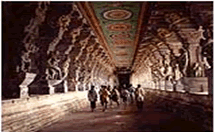
The long-corridor in the temple at Rameshwaram
I was fascinated by the immense temple there,
with its soaring gopurams ~ gate-towers ~
sculpted with tier upon tier of gods, goddesses and
fantastic beings in their various realms, and long
corridors inside, lined and supported by a thousand
pillars, it is said (I didn’t stop to count,
but there might well have been). There were also large
pools of water known as tanks inside the temple, where
people would bathe, considering it lucky to do so;
I tried it, too, but fish nibbling at my feet soon
made me come out. At times of puja, the sound of trumpets
and rattle of drums echoed through the halls and corridors;
I found karnatic music hypnotic. Then, too,
there was a temple elephant ~ a baby ~ that would
touch your head with its trunk in benediction if you
gave it a coin; I was later allowed to mount and sit
on its back when I’d become friendly with some
of the priests there.
One day, near the temple, I was approached on the
street and singled out from the others by a sadhu,
a small, wiry man clad in just a loin-cloth, and with
long hair and beard, who invited me to stay with him
in a pilgrims’ rest-house known as a ‘dharmasala’.
Why me, I can’t say, and I don’t believe
in predestination, nor do I believe there are such
things as ‘accidents’. I accepted his
invi-tation without hesitation, leaving the English
guys, who hadn’t been my type anyway, being
like football-hooligans, and moved in with him, sleeping
on a mat on the floor, bathing at the well, and eating
the food ~ vegetarian, of course ~ he provided me
with. I stayed with him ~ Jagadish Narayan was
his name ~ only a few days; he spoke no English, and
my Hindi (he was from north India, not the south,
and spoke Hindi rather than Tamil), was very limited,
and so we couldn’t communicate verbally, and
although he taught me nothing I can put my finger
on and say, “I learned this from him,”
or initiate me into any supramundane mysteries, or
even give me a new name, he gave me something better:
a sense of direction in my life that I’d not
had before; he lit my lamp and kindled my flame; the
rest was up to me.
I went to Sri Lanka and spent a week there, visiting
several places and attending the annual Pera-Hera
in Kandy, but it didn’t do to me what
India did, so I returned to Rameshwaram, hoping to
spend more time with my guru ~ for so I regarded him
by then ~ but he wasn’t there; where he had
gone, I couldn’t as-certain, but to such a homeless
one, everywhere is home.
No longer feeling a great urge to get to Oz quickly,
I resolved to travel around and see some of the ancient
and holy places with which India abounds, thinking
it might be my last time there and that I shouldn’t
miss the chance. Consequently, I did this, going first
to Madurai, not too far away, where there
is a splendid and even larger temple than that of
Rameshwaram, dedicated to a goddess named Meenakshi.
Although fascinated here, too, I didn’t feel
what I had at Rameshwaram, which was more signifi-cant
to me than Madurai.
I returned to Madras, then passed through Kanchipuram
(an-other ancient temple-town), and Bangalore (a modern
nonde-script place). Mysore had quite a lovely feeling
about it. Using it as a hub, I made several short
trips to places not far away be-fore going on to the
west coast. Then it was down through Ker-ala to the
southernmost tip of that vast and fascinating country,
Kanyakumari, where I was present at the Opening
Ceremony of the shrine dedicated to Swami Vivekhananda
that had been built on a large rock just off
the coast ~ an imposing structure.
In Madras again, I asked at the Chartered Bank if
I might leave some money there while making my trip
up north, as I didn’t want to carry it all with
me. I explained my purpose to a young Brit and he
very obligingly offered to put it in a safe-deposit
box for me, at no charge ~ very unusual for a bank!
Then, unencum-bered, I caught a train heading north
along the coast, but without a ticket. All went well
for some hours; I sat in an open doorway with my feet
hanging outside, gazing at the countryside as we passed
by; India has a wonderful variety of brightly-plumaged
birds which the people leave alone and in peace.
Suddenly, the train slowed as it came to a station,
and because my feet had been hanging outside the train,
my right foot caught against the platform and was
slightly grazed; no problem I thought, just a scratch.
Not long after, an inspector appeared, and was not
at all happy that I had no ticket, so hauled me off
the train, and gave me a real reprimand ~ and quite
rightly, too! Then he let me go, with a warning not
to repeat my misde-meanor. By then, I’d found
that I couldn’t wear my flip-flops be-cause
of the graze on my foot, which was just where the
side-strap would have been, so I had to go barefoot.
Again, no prob-lem, I thought; the soles of my feet
were quite tough, and could stand it. I walked away
from the station, out of the town, and got onto the
highway, and soon got a ride to Hyderabad, where I
had a quick look around, then set off for Poona. Still
hitch-hiking, I reached Ellora the next night,
and slept under some trees; this was north-east of
Bombay, in rugged and arid countryside. In the morning,
I went to explore the nearby cave-temples ~ or rather,
monasteries. There are Buddhist, Hindu, and Jain caves
here, carved out of an escarpment over a period of
a thousand years, and renowned, worldwide, for their
size, splendor, and art. As monasteries, they are
deserted now, but preserved as national monuments,
open to the public.
I‘d already learned something of Hinduism, and
was impressed by its scope and twin-concepts of Karma
and Reincarnation; compared with what I’d been
taught of Christianity, it was like standing on a
mountain looking at the world below in all direc-tions,
while before, it had been like looking at the world
through a key-hole; the single-life-on-Earth belief
is very narrow and un-satisfying, raising more questions
and doubts than it answers.
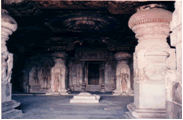
Inside one of the Buddhist Caves at Ellora
At Ellora, I felt a thrill, as if something
had awoken in me. I knew nothing of Buddhism so far,
had met no Buddhists, and had not read the book on
Buddhism I had with me. The only thing I thought I
knew about Buddhism was that the Buddha was a great
fat man who sat beneath a tree, waiting for people
to come along and feed him, and even this was wrong;
where I got this idea, I don’t recall, but there
are many people with such false perceptions. So, it
cannot be said I was looking for Buddhism, or that
I found it; it might be better to say that it found
me. At Ellora, therefore, I was first stirred by Buddhism,
but this was not the beginning; I can trace it further
back from there, as I will show.
From Ellora, I went to Ajanta, a group of
thirty caves ~ all Bud-dhist, no Hindu or Jain caves
here ~ 80 miles away. It was late when I reached the
access-road, however, so I spread my sleeping-mat
under a tree, unaware that this was tiger-country.
When I awoke, I felt a sharp pain on the sole of my
right foot, and investigating in the half-light, discovered
a white spot, which was hard and extremely sensitive.
Because I’d been walking barefoot, I must have
trodden on a thorn the day before, but I didn’t
recall having done so; maybe, at the time, I thought
it was just a sharp stone (some days later, my left
foot was pierced by a thorn, with a similar effect,
so I guessed the first wound had been so-caused. Thorn-bushes
are common in India, and the thorns thereon are very
long and poisonous).
It was difficult to stand and walk on my pierced foot
so, thinking to alleviate the pain, I cut open the
spot with a sharp knife to let out the pus, applied
some ointment, bandaged it with a strip of cloth,
and set off to hobble the remaining distance to the
Caves. But perhaps because of the pain and the effort
needed to walk, when I got there, I was ‘high,’
and passing from cave to cave, many with images, frescoes
and long-abandoned monks’ cells, I had a strong
feeling ~ a conviction, even ~ that I was
coming home again after being away for a long time.
Did I bring this upon myself, did the pain in my foot
have anything to do with it, or was it something welling
up from my subconscious? I can’t say for sure,
but it was a great turning-point in my life, and I
felt that whatever had caused men to carve these magnificent
sanc-tuaries out of the rock, this was it for me.
From wandering around aimlessly, I now knew which
way to go; I had a light to guide me. Because of this,
Ajanta is of greater significance to me than Ellora.
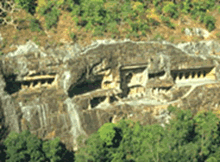
Partial-view of Ajanta Caves
Two days later, with my foot still bandaged
and sore, I went to Sanchi, in Central India, where
there are several well-preserved Buddhist stupas,
or reliquary monuments, the largest of which was constructed
to enshrine relics of the Buddha’s two chief
dis-ciples, Sariputra and Moggallana.
I was struck by the atmos-phere that lingers at this
place, but was appalled at the lack of respect of
Indian visitors to the place, some of whom I saw clambering
on top of the main stupa to have their photos taken.
Perhaps it’s because India has a super-abundance
of ancient and holy places, and people have grown
used to and taken them for granted, without understanding
or appreciating them.
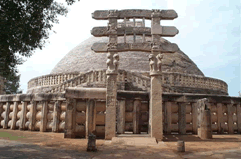
The Great Stupa at Sanchi
Walking down the road from the sacred hill,
trying to catch a ride to Bhopal, suddenly,
I ‘disappeared’ ~ that is, my body was
there, as normal, but the ego, or the sense of ‘I,
me, mine,’ was not, and my consciousness exploded
or expanded. Knowing nothing, as yet, of such things,
even by reading, I saw, felt, or experienced life
as a whole, with no barriers or limits, and knew where
the center of the Universe was/is: HERE.
This was ac-companied by an intense feeling of joy
and love such as I had never known before; I felt
at one with everything. It was a most illuminating
experience, and I wanted so much to share it with
someone, but there was no-one. I am not saying or
implying that I became enlightened thereby, and it
shouldn’t be thought so, but it was certainly
a transcendental or enlightenment experi-ence. It
didn’t last, of course ~ I couldn’t sustain
it ~ and I fell back; but it left me with an unshakable
conviction about what I had seen: that we are not
this small and narrow thing we call ‘I’,
but something much, much more.
Soon after this, I read the book I’d been carrying
with me, enti-tled simply: Buddhism, by Christmas
Humphries, and I must here acknowledge my gratitude
to the late founder-president of the London Buddhist
Society, as his words and explanations made complete
sense to me, and left me in no doubt whatso-ever that
what I had stumbled upon just a short time before
was the way which I should henceforth try to follow.
It wasn’t a matter of belief, for I had seen
and experienced it.
From there, it was not much of a choice to make to
become a monk; it seemed the logical thing in order
to realize what I had glimpsed.
Traveling on, in Rajasthan, I met someone who took
me to an ashram that had coalesced around
a woman called Suttee Mata, who, it was claimed,
had not eaten or drunk even a drop of wa-ter for 28
years! Incredible though this seems, it is not the
only case of its kind; I’ve read of a woman
in Bulgaria who was sup-posed to be like that. Anyway,
I’m only reporting what I was told, and India
is a country of strange and mysterious things. Appar-ently,
she was married at an early age, but before the marriage
was consummated, her husband died, and she entered
upon a period of mourning, eating nothing at all.
When the mourning was over, and she came to eat, she
was unable to. She was strong and fit, so fit, in
fact, that when she went on pilgrimage in the Himalayas,
her followers had difficulty keeping up with her!
Her story was quite well-known, and she’d been
subjected to rig-orous observation by Western researchers,
who concluded she wasn’t cheating by eating
and drinking when no-one was around, but they couldn’t
explain her condition. Her followers claimed that
she lived on prana, the life-force in the
air. I stayed there for 3 days, and as in most such
ashrams, the people were kind and friendly; I was
well looked after. I’d be more skeptical about
this now, but dare not say it’s impossible;
I just don’t know.
In Jaipur, I saw some of the sights, including the
Hawa Mahal (Palace of Winds), the 18th century
Jantar-Mantar astronomical observatory and
the stupendous Amber Fort. Also, because
my thorn-pierced feet were still infected and painful,
I went to a gov-ernment hospital to ask for a shot
of penicillin, and eventually got a shot of something
or other, but maybe it would have been better had
I not, as you are more likely to catch something in
such hospitals than get cured of anything. I can’t
say I did for sure, of course, but I developed what
appeared to be jaundice some weeks later.
I reached Delhi soon after this, and spent a couple
of days there during the festival of Dussehra. From
there, I went to Amritsar in Punjab, and
after visiting the Sikhs’ Golden Temple, with
its mu-seum of gory paintings depicting the massacres
and persecu-tions the Sikhs had undergone under Mughal
rule of previous centuries, I turned south again,
to be picked up by a wealthy farmer and invited to
spend some days at his home. I accepted, and was treated
kindly enough. He took me to visit some of his friends,
and made a big thing out of the fact that I used a
rush-mat for sleeping on, just as they did; he must
have been sur-prised or shocked that a white sahib
should lower himself so! While we were out, some members
of his family could not resist going through my bag
to see what it contained; privacy is a con-cept unknown
to lots of people, it seems.
Anyway, while there, I observed someone beating a
buffalo with a thick bamboo staff, so I asked the
farmer to give me this staff, and he did; it probably
wouldn’t save the buffalo being beaten, as I’m
sure they had other staffs for that, but it was certainly
useful to me, and when I left to resume my journey,
I began to carve it while waiting for rides, until,
some days later, it had be-come quite a work of art,
even if I say so myself. This particular staff was
solid, not hollow like most bamboo, and so was very
strong. Now, a staff in India has many uses, and not
just as an aid for walking; it acts as a visible deterrent,
both for dogs, mon-keys, and people who otherwise
might disturb you; I never had to use it to defend
myself, but I’m sure it was effective. And I’ve
always liked to walk with a staff; it’s like
having a third leg.
Back in Delhi, I went to the Nepalese embassy for
a visa, nec-essary before going to Nepal in those
days. I got one, valid for 15 days from date-of-entry.
Then, as I was making my way out of the city, to a
highway to hitch a ride in the direction of Benares,
a Buddhist monk (the first I’d ever met), asked
me where I was going. When I told him, he said it
was getting late and would soon be dark, so it might
be better if I spent the night at his temple nearby,
and go on the next day. I accepted, and followed him
to the temple, which was a simple affair of corru-gated-iron
with a bo-tree in the compound. He introduced me to
his brother-monk who, like himself, was from Chittagong
in East Pakistan. I was received kindly and a
charpoy was placed out in the yard for me beneath
the stars; in October, this was quite suitable as
the rainy season was over and the nights were mild.
I don’t recall being bothered by mosquitoes,
so there probably weren’t many, and those there
were I was able to tolerate.
The next morning, Venerable Dhammika ~ for
such was the friendly monk’s name ~ invited
me to go with him to the home of some of his supporters.
I accepted, and on the way there, he told me that,
a few days before, one of the children of the family
we were going to visit had been knocked down by a
car and killed; the funeral was already over, and
he was going to give a memorial sermon.
Before going on, I should say that, Ven. Dhammika
being the first Buddhist monk I had ever met, I was
ignorant about the life-style of monks, and so I thought
nothing of it when he instructed the family to prepare
a seat for me alongside his against the wall, and
to serve food to both of us, while the people sat
facing us. So I sat there and ate, unaware that monks
of Theravada Buddhism ~ of which he was a follower
~ never ate together with non-monks but always apart.
Maybe he thought it would be in-convenient and embarrassing
to explain this to me, or maybe he placed little importance
on this custom and was ready to over-look it; I do
not know. Maybe he was just kind; this I know.
After we’d finished eating, and the plates had
been cleared away, he took a long-handled fan that
he’d brought with him (and which is used by
some monks while preaching) and, hold-ing it before
him so that the people could hear him but not see
his face, he began to speak. Now, I didn’t understand
a word of what he was saying, although it must have
concerned the child’s death. But, whereas the
people in front of him couldn’t see his face
because of the fan, still sitting beside him, I could,
and saw that, while speaking, he was weeping, with
tears rolling down his cheeks. This moved me, for
I saw that he cared so much about the people to whom
he was speaking, and shared their loss and sorrow.
I didn’t know then that monks are not supposed
to show their emotions but should restrain themselves.
On the other hand, however, we are taught to consider
others as ourselves, and to feel their suffering and
pain as our own, for it is by identi-fying with others
that compassion arises.
I will state clearly here that I was far more impressed
with Venerable Dhammika, who couldn’t hold back
his tears in sympathy with the family over their loss,
than with all the stony-faced monks and nuns I’ve
seen performing ceremonies over the years ~ far
more impressed, and favorably so! Should a monk make
his heart cold and hard like a stone, which almost
nothing can move? Everyone knows that no-one lives
forever, and that it’s only a matter of time
before we all go through the portals of death; increasing
detachment and equanimity result from reflec-tion
on this and insight into how things are, but have
nothing to do with mere unconcern or indifference
towards others.
I spent three days with these monks, during which,
the brother-monk, noting my interest, asked me if
I’d like to become a monk, and if so, he would
ordain me. I told him I would (I had already decided
after my experience at Sanchi), but that I wasn’t
yet ready as I first wanted to visit my parents in
Australia and tell them, in person, that I would be
going back to India to become a monk. Thanking them,
I left, and went on my way.
Over the years, I’ve thought many times of Venerable
Dhammika and his kindness to me. He was the first
monk I met, and without meaning to, he gave me something
that has stayed with me until now: an example of humility,
kindness and concern for others. I am fortunate to
have met him, particularly at that stage of my life;
his example has helped to sustain me through times
of doubt and depression. Wherever he is now, I wish
him well in every way, and am grateful to him forever!
On my way to Benares, I was picked up by some English
guys, but they were on a ‘hipper-than-thou’
trip, and although they were going to Kathmandu, they
made an excuse to drop me off after an hour or so.
No problem; before long, some French guys and Norwegian
girls in a camper-van stopped for me; I was lucky
again, as they were also going to Kathmandu. We stopped
in Benares overnight for them to get visas for Nepal,
they stay-ing in a hotel, while I slept in the van.
We visited the burning-ghats and some other places,
and then got moving again. At Patna, we had to cross
the Ganges, which is very wide here. There was no
bridge at that time so we had to go by an anti-quated
ferry, and I recall watching Indians in their white
clothes getting covered in soot-spots from the black
smoke belching from the funnel.
We reached the border at Raxaul, and entered
Nepal; Kathmandu, the ultimate destination of many
hippies, was still 100 miles away, behind and over
the foothills of the Himalayas, shel-tered and shielded
in its beautiful and fertile valley. To reach it,
we had to follow the steep and tortuous Tribhuvan
Highway, the only road into Nepal at that time, built
by India in the ‘50’s at great cost and
loss of life to connect Kathmandu ~ hitherto quite
inaccessible ~ to the outside world; China later built
another road down from the Tibetan border.
Through Hetauda in the Terai ~ Nepal’s
plains ~ we took the winding road to its highest point
at Daman, from where there is a fantastic
panoramic view of the Himalayas when the weather is
fine ~ as it was then in early November ~ stretching
in a vast semicircle of snowy peaks from east to west
(actually, the San-skrit word, Himalaya,
means Abode of Snow). It was then a long
and at times hair-raising descent to Naubise,
from where the road climbed, by a series of switchback
bends, to reach the rim of Kathmandu Valley at Nagdhunga
far above. Then it was downhill to the medieval city,
with several rivers running through, and its narrow
streets converging like spokes to a hub, connect-ing
to similar-looking hubs in a confusing manner. My
friends checked into a hotel in the centre of town,
parking their van nearby, and I went off to explore,
drawn, as if by a magnet, to Swayambhunath,
an ancient stupa on a hill a mile or so west of the
city, which has a special aura about it, as people
have been worshipping there for maybe 2000 years.
Hippies called it ‘the Monkey Temple’
because of the great number of macaque monkeys that
inhabit the wooded hills and shrines there; they are
ugly, vicious and quarrelsome. On my way there, I
saw the van with the English guys who had given me
a brief ride; they had just arrived, and seemed surprised
to see me.
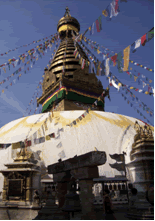
Swayambhu Stupa, Kathmandu
By that time it was late afternoon; after
sitting in meditation for a while, night was almost
upon us, and night falls quickly here, with barely
any dusk. I had nowhere to stay unless I went back
to the town to sleep in the van, but I wasn’t
worried, even though it was getting cold, and intended
to sleep outside somewhere. As I was looking around
for a suitable place, however, some Ti-betan monks
came along, and asked what I was doing. When I told
them, they beckoned me to follow them, and led me
to the upper room of a building nearby where they
gave me a blanket and a mat on the wooden floor; I
was very grateful for this. They had similar beds
on the floor. I spent quite a comfortable night, and
thanking them the next morning, went to meditate on
a slope nearby, among the shrines and votive stupas.
I hadn’t been there long when monkeys began
to gather around me, bent upon mischief, as is their
wont; they are always on the look-out for food, and
are so bold that if they see anyone holding anything
edible, they are quite likely to snatch it, and sometimes
bite while doing so. I had no food, however, but a
little con-cerned that they might attack me anyway,
I assumed a Buddha-like posture with one hand raised
forbiddingly, figuring that they might be familiar
with this mudra from all the images round
about, and sure enough, they calmed down and sat quietly
around me; I thought it was strange.
I returned to the town to have a look around there,
and told my friends I would go to explore the valley
somewhat ~ it’s an ex-tensive valley, many miles
wide and long, and I wouldn’t get very far.
Off through the fields and villages I went, and climbed
a hill some hours out, until the light started to
fade, and I again had to look for a place to spend
the night, under a tree, perhaps. Just then, some
people came up the path from the valley below, and
by signs, asked where I was going to stay and eat.
I shrugged to indicate I didn’t know, whereupon
they gestured for me to follow them, and led me to
a house perched on the edge of a steep slope, and
told me to sit. Others gathered to look at me suspiciously
and not in a very friendly way, as if I was some kind
of ghost or demon. Some of them wanted to know if
I had a camera, but I didn’t; they began to
look in my bag for something of value, but it contained
only clothes and a few books (what lit-tle money I
had I always kept on my person). I was offered rice
and vegetables, and they sat around intently watching
me eat, as if waiting for something to happen; I had
the feeling that they might have put something in
the food to drug me, but I sat cross-legged, firmly
and upright, focusing my mind, and nothing hap-pened.
Afterwards, I was given a place to sleep on the veran-dah,
with some dirty and smelly covers, but before I was
allowed to settle for the night, they asked if I would
like a young girl to sleep with, and when I signed
‘No,’ they obviously thought I might prefer
a boy, and so one of the younger males started to
get in with me, but I shoved him out. Only then did
they give up on me and I was left alone to sleep.
In the morning, when I left, they stood outside the
house watching me go down the hill until I was out
of sight, as if to make sure I had left their territory;
I felt lucky not to have been robbed or even killed!
On the way back to Kathmandu, I passed the immense
Bodnath stupa, around which Tibetan refugees
had settled and estab-lished monasteries and businesses;
they are very enterprising.
I made another trip out of the city, walking to Nagarkot,
a hill of some elevation from where there is a good
early-morning view of the Himalayas as the sun rises
over them; Everest is also visible, but although it
is the highest mountain on earth, it looks small as
it is far away. I spent the cold night in a simple
lodge. Descending, I passed through the third of the
valley’s ancient cities, Bhaktapur,
which is perhaps the best-preserved of the three;
the carved multi-tiered temples there, set on stepped
plinths, are very striking.
My remaining time in Kathmandu was spent wandering
around the city, and when it was time for my friends
to leave and return to India, I went with them; our
15 days were almost up.
Crossing the border, I parted from them and made my
way to Benares, where I walked across the Ganges bridge
heading south, and by a number of rides, reached Goa
and spent two weeks with friends on Anjuna Beach.
I then set out for Madras, where I retrieved my funds
from the bank, and bought my plane-ticket to Adelaide,
because some months earlier, the migrants had arrived
in Australia, been through the hostel-stage, bought
a house in one of the suburbs north of Adelaide, and
already had jobs; George had arrived before them,
and was living in town; he’d also found work;
it was easy in those days.
But I’d become sick, and was convinced I had
hepatitis; I had all the symptoms ~ yellow eyes and
skin, dark urine, pale feces, pain over my liver,
and easily got tired, so that the daily walk to the
post-office left me exhausted and I had to rest on
the bug-infested benches to recover before standing
at the counter to check for mail. I’d seen so
many cases of hepatitis among hip-pies that I knew
what to do to treat myself; I immediately went on
a diet without oil, got some ayurvedic medicine
for this dis-ease, and rested a lot, and by the time
I was ready to fly out ten days later, the symptoms
had almost gone, but that was a hard time, and not
very enjoyable. (Strangely enough, when I was tested
~ some years later ~ for the antibodies that should
have been there if I’d had hep, there were none,
and I found this hard to understand, because although
I’d not been officially diag-nosed as having
it, I’d certainly had all the symptoms, and
the way I’d felt was not an illusion, nor do
I think it had been psycho-somatic. Had I misdiagnosed
myself? Perhaps. Or maybe the ayurvedic medicine was
extremely effective.
|