So Many Roads ~ ORDINATION
“Ethical behavior should
be based effectually on sympathy, education and social
ties and needs; no religious basis is necessary. Man
would indeed be in a poor way if he had to be restrained
by fear of punishment and hope of reward after death.”
~ Albert Einstein: Religion and Science
~
Having
decided to become a monk, my ordination was arranged,
and I learned the Pali formula I would have to recite
during the ceremony. My hair and beard ~ which had
become progressively shorter over the previous months,
anyway ~ were shaved, and the next day ~ the first
Sunday in May ~ I was taken to Wat Chayamangalaram
~ the main Thai temple in Penang ~ where the ceremony
was held. Ray, Dorothy and other friends came, and
I got through it and emerged in saffron robes and
with a new identity ~ Abhinyano, which was
the first part and the last part of my teacher’s
name: Abhi-dhamma-pala-nyano.
We returned to MBMC immediately afterwards; I didn’t
stay in that awful temple. The reason I say ‘awful’
is because of its blatant focus on making money; you
were unlikely to get any Dharma-instruction there,
and the only enlightenment would be a lightening of
your pocket! I’d be very surprised if it’s
changed since then. It is frequented by local Buddhists,
as well as being on the ‘must’ list for
foreign tourists. Some years later, I went there to
see how things were; around the huge reclining-Buddha-image
were numerous other images, each with a donation-box
before it bearing inscriptions like: “If you
pray to this Buddha, you will be happy”; “If
you pray to this Buddha, you will be lucky”;
“If you pray to this Buddha, you will be wise”;
“If you pray to this Buddha, God will bless
you,” etc. ~ the very opposite of what the Buddha
taught! I counted no less than forty donation-boxes
(as well as ‘fortune-telling’ machines!)
around the main image. Now, gullible people (of which
there is no shortage), eager for happiness, blessings,
luck, and so on, might put money in each box, and
the temple-people would rub their hands. But what
would foreign visitors think? If they went
there with open minds, not unsympathetic towards Buddhism,
but came away thinking of it as a thing of superstition,
greed and exploitation, I would quite understand;
if I had not seen any deeper than just the
façade, I would have felt that way myself!
Before my ordination, I had just $135 to my name,
but thinking I wouldn’t need money any longer,
I sent this to my mother. I had the idea that I’d
find a sense of fellowship and brotherhood in the
monasteries of Thailand, but was soon to be disillusioned.
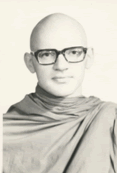
Newly ordained
Of course, I felt awkward as a monk at first,
especially when people offered food and hovered over
me while I ate, so solicitous of my welfare that I
felt like a monkey in the zoo. I couldn’t eat
my fill from fear of being considered greedy, and
wanted to say, “You are very kind, and I appreciate
it, but would you mind leaving me to eat in peace?”
I still feel this way.
Soon after ordaining, I organized a blood-donation,
and persuaded a number of people from MBMC to accompany
me to give blood; I continued to give blood on a regular
basis from this time for many years ~ no more selling
~ eventually reaching 65 donations before prevented
from further giving by diabetes; but I’m jumping
the gun again.
My visa about to expire, I got one for Thailand, ready
to leave; Luang Pau gave me 500 baht to go with. There
was an Indian from Bangkok staying in MBMC at that
time, though what he was doing there, I never discovered.
Anyway, he wanted to return home, so Luang Pau entrusted
me to his care ~ giving him money, too ~ and we set
out for the border, but having crossed, he slipped
away, taking 200 baht of the money Luang Pau had given
me. I was stranded, but someone soon took me to the
local wat (monastery), where I was welcomed and stayed
for a couple of days before going on by train to Chaiya.
There, the famous teacher, Buddhadasa, had
his monastery, Wat Suan Mokh. Now, Luang
Pau had not wanted me to go there, as some people
considered Buddhadasa too liberal, with somewhat unorthodox
views, while Luang Pau was strictly Burmese vipassana
in his, but I went anyway, and although I noticed
nothing extraordinary about Buddhadasa except his
friendliness, I had quite a nice time there, joining
the other monks on alms-rounds in the early morning,
and sitting around in a large circle in the forest
with Buddhadasa in a prominent place to eat afterwards.
Some other Western monks were staying there at the
time, including a German, whose name was Santitthito,
a heavily-built man who was a little hard of hearing.
I asked him to tell me, in Thai, how to say “I
don’t speak Thai” (I didn’t know
a word of Thai at that time); he told me, “Pood
Thai mai dai.” I thought I’d be able
to deal with any situation that arose whenever anyone
spoke to me in Thai; all I’d have to do would
be to retreat behind those four words. Alas, when
the time came, I’d forgotten the word ‘pood,’
which means ‘speak,’ and said just “Thai
mai dai,” which somehow ~ as Thai is a
tonal language, and if you use the wrong tone, even
if you get the word right, you may easily say something
wrong, and sometimes disastrously so ~ meant, “I’m
unable to defecate”. I probably got some quizzical
looks, as if to say, “Now, why is he telling
us that?”
I’d been assigned a small kuti ~ monk’s
hut ~ in the forest, and was left alone. This is how
it is, I thought, so settled down to meditate as I’d
been doing in Malaysia. But this was Thailand, with
quite a different and unfamiliar environment; I was
new as a monk and knew no-one there, as the Western
monks had already left; I became quite nervous, so
nervous, in fact, that I developed a stutter, which
I’d never had before, and felt that if I continued
to meditate alone, I would become mad; so I gave up
formal meditation until I should feel more stable.
Soon afterwards, I went to Bangkok, to a well-known
monastery named Wat Cholabatthan. I had a
letter of introduction from Luang Pau to one of his
friends, a senior monk there, only to find that he
was away. I visited the abbot Ven. Panyananda,
a good friend of Buddhadasa, who told me I could stay
there for some days, and that there was a German monk
who would help me with my needs. I thanked him ~ he
spoke English well, as did Buddhadasa ~ and I was
taken to a kuti and given the key thereof before being
led to the hut of Dhammaviro, for such was
the German monk’s name. He didn’t seem
surprised to see me and invited me in, saying that
he’d been expecting me. “Expecting me?”
I said. “How did you know I was coming?”
“Oh,” he said, “Good news travels
fast” (Santitthito had reached Bangkok before
me and told him I was on my way, it seems). Anyway,
Dhammaviro was my first real friend in Thailand and
remained so for many years, until, after meeting him
in Munich in 1995, we lost contact, and I have grave
doubts of his safety, as the last I heard of him,
he was living on a beach somewhere north of Phuket;
I hope he survived the tsunami.
From Wat Cholabatthan, I sought shelter in Wat
Pleng, nearer the city, and was introduced to
the deputy-abbot, Phra Prasert. But no-one
told me of his rank or position, and so I didn’t
greet him as he was used to being greeted; he wasn’t
very friendly towards me because of that, and of course,
I had to deal with him quite often, as he spoke English
well. Nevertheless, I was assigned a kuti.
A number of other foreign monks were there at that
time, and so I met Bill ~ a brutal kind of American
~ and his wife, Michelle, both of whom had ordained
as monk and mae-chi (the nearest Thais have
to nuns, although on a much lower level than monks,
and were treated abominably, as menials, and they
accepted it, too); there was also John, from Melbourne,
whose ordained name was Jagaro, Paulos, a
Hungarian doctor, and Michael, a German,
who was soon to become a monk, and with whom I formed
a close friendship. Then, there was Bobby’s
young son, Sean; they had arrived in Bangkok before
me, and she’d taken him to Wat Pleng with the
idea of letting him ordain as a novice for a while
(she was probably glad to get him off her hands, too).
He was to prove a headache to many people, including
myself!
From the time I arrived in Thailand, the first letter
I got from home brought the terrible news that George
had committed suicide. He had been found hanging from
a tree in the hills outside Adelaide, still sitting
on his motorbike. Apparently, he’d tried several
times to end his life. He didn’t leave a note
telling why he’d done it, so we never knew,
but it seems he was schizophrenic, although he’d
not actually been diagnosed as such. For a mother
to lose a child that way is enough to break her heart.
Mum’s hair turned white almost overnight. I
was so far away, and there was nothing I could do
except meditate for her and him. Poor George!
My first few months in Bangkok were not easy, and
for a while I was so poor that I didn’t have
enough to buy a stamp or soap. But that didn’t
last, and whenever I received offerings, I made a
point of sharing them with some of the boy-monks who
had even less than me. I’ve never really been
short from then until now.
I wasn’t pleased to see some of the things that
went on. Monks who had learned how to chant well ~
even if they didn’t understand the meaning of
what they were chanting ~ were often invited for house-blessings,
funeral-ceremonies and such like, for which they received
offerings in the form of money, towels, toiletries,
and so on. Instead of sharing them with others who
had little or nothing, some monks would now and then
send someone to a shop to sell the things they had
accumulated.
Every morning, like the others, I would go on alms-round,
and really enjoyed this. It is not begging, as is
commonly assumed, as we do not ask, but just receive
whatever people are willing to give; people wait outside
with the food they have prepared, for the monks to
come along; the monks see them waiting, and approach
them demurely. But there are so many monasteries and
monks in Bangkok that sometimes it is not easy to
get enough to eat. On days of new-moon and full-moon,
however ~ days which, according to tradition, are
considered special ~ so many people wait to offer
food to the monks that they receive too much. Now,
why this imbalance? Why, on most days, do some monks
get barely enough to eat, but on two days of the month,
they get a surplus? Because it is considered that
offerings made on these days will produce more merit
than those offered on other days. It is not so, of
course, but that’s what people believe, and
shows that desire for merit is in their minds. Had
it not been like this over the centuries, however,
monks would have found it very hard to survive.
Not everyone knows who Bodhidharma was, so
I will introduce him briefly, before telling something
of him that is relevant here. Bodhidharma was an Indian
monk who lived in the 6th cent CE and was acknowledged
to be the 28th of a line of masters going back to
one of the Buddha’s chief disciples, Mahakasyapa.
This line of teachers had preserved a special kind
of teaching on meditation. When Bodhidharma went to
China to propagate these teachings he became the 1st
Patriarch of the Ch’an School of Buddhism
there (known later as Zen in Japan). Not
long after arriving in China, his fame reached the
ears of the Emperor, who was a good and pious Buddhist,
and he invited Bodhidharma to the palace for an audience.
When he came, the Emperor received him respectfully,
and told him of all he’d done to promote Buddhism
in his realm, and asked how much merit he had made
thereby. He was very surprised when Bodhidharma bluntly
replied: “None whatsoever, your Majesty!”
“Then what is the purpose of the Buddha’s
Teachings?”
“Nothing holy, but pure emptiness,” said
Bodhidharma, which confused the Emperor even more,
and Bodhidharma left without explaining what he meant,
and went to sit in cave for nine years.
This story has been told and retold countless times
over the centuries, and it has been accepted that
the Emperor was suffering from delusion and wrong
view; Bodhidharma’s manner is seldom questioned.
He is supposed to have been enlightened before going
to China, but if so, why need to sit in a cave for
so long, seeing no-one and saying nothing? And why,
if he was so wise ~ even before his enlightenment,
if that is what happened in the cave ~ and cared enough
about the propagation of Buddhism to go to China in
the first place, did he not explain his meaning to
the Emperor, who was not only a good man, but had
tremendous capacity to lead many others to a better
understanding if he had understood better himself?
Surely, this was a mistake on Bodhidharma’s
part. Why speak so cryptically when a simple explanation
might have produced a much better result? (It is said
that later, when someone else explained Bodhidharma’s
meaning to him, the Emperor did understand, so why
didn’t Bodhidharma explain it himself?) Many
followers of Zen ~ especially Western Zen aficionados
~ are guilty of this kind of thing, and it is done,
in many cases, to display their grasp of the subtleties
of things they think are beyond ‘lesser mortals’;
it is often just a game, a silly show, and nothing
to do with Zen.
Bodhidharma might have explained that actions done
with the aim of getting returns will produce corresponding
results on the material level, but not merit,
which has the function of decreasing the
defilements of Greed, Hatred and Delusion; in fact,
greed is only increased thereby. Merit is
the result of actions done through understanding,
knowing they are the right things to do. And the freer
actions are from the desire for results, the greater
will be the merit; conversely, the greater the desire
for results, the less merit where will be therefrom.
How we do things is just as important as what we do.
What we received in our alms-bowls had to serve for
two meals, breakfast and lunch, after which we would
not eat again until the next morning. This was/is
one of the monks’ rules, but more importance
is placed upon it than should be. It is a training-rule,
to help discipline oneself so that one can stand hunger
instead of over-indulging. It is not a moral precept,
and does not make one any better than those who don’t
follow it. Moreover, the Buddha promulgated this some
years after he began His ministry, which clearly indicates
it was only a minor rule. And following it without
understanding will bring one no nearer to enlightenment,
and in fact, will only bind one more firmly. Whatever
we do should be done with understanding, not from
fear of punishment or desire for reward, and we should
beware of becoming proud of it.
It has been a custom since ancient times for monks
to spend three months of each year in so-called retreat;
it is known as The Rains Retreat because
it was held during the monsoon, when it was hard to
wander around, as monks normally did; thus, it would
be a time for monks to rest, and focus on meditation
and study. And, knowing where the monks would be at
that time, it was also an opportunity for people to
get more Dharma-instruction. This custom has largely
lost its meaning now, as most monks stay in one place
year-round anyway, and no longer wander from place-to-place
as they did originally. It is still observed by Theravada
monks, but not always by others.
Michael was ordained before the start of the Rains’
Retreat, and given the name, Madhavo; and then, together
with Paulos, Bill and Michelle, went to stay in a
beach-side monastery near the Cambodian border. Young
Sean was also ordained as a novice, and I was asked
to take charge of him, but this didn’t work
out, and he was sent to join the others at Ranong.
I was then the only Westerner in Wat Pleng for a while,
but didn’t really mind that; as it was more
incentive to learn Thai. Now, Paulos had left some
stuff with me that included a typewriter. I’d
never touched a typewriter before, and decided I’d
like to try, so wrote and asked if I might use it,
and when his reply came authorizing me to do so, something
came into my life that would ultimately change it
quite a lot, and although I never got beyond pecking
at the keys with just two fingers, I became quite
fast, and it opened doors for me. I had always been
a letter-writer, and my mother used to say that she
was always thankful that I wrote home regularly. Because
I used to write very finely by hand, I could get 150
lines on an aerogram, and Pete once replied to me
and said, “Thanks for the book!”
During the Rains, for days on end there were torrential
downpours, so that the grounds of the monastery became
a virtual pond, and the frogs therein set up an infernal
chorus; the sun couldn’t break through, and
wet clothes became mildewed, unable to dry, but this
is how it normally is every year, and if the rains
fail, you get drought; it may not be very comfortable,
but consider the alternative.
Halfway through the Rains, an Australian named Alan
Driver arrived to stay; he spoke Thai well, having
been teaching English in Bangkok for some years, and
was also soon to ordain. So I had some English-speaking
company. And there was a Brazilian monk who kept to
himself, meditating alone; I sometimes shared my food
and other things with him, as he had often had less
than me. Also, there was a Cambodian monk who I sometimes
used to talk with, but he was reclusive, and one day,
was found hanging in his kuti; he’d been so
concerned with getting results from his unsupervised
meditation, and something had snapped.
It wasn’t long before Sean made himself such
a nuisance that Bill took it upon himself to disrobe
him. He was then brought back to Bangkok to stay with
his mother; they eventually left Thailand and returned
to Penang, where enterprising Bobby got a job on a
yacht in some capacity, and that took them to Israel.
We kept in touch over the years, and I will tell more
of her later.
One time, down with tooth-ache, I went along to a
government hospital which had a dental-section. Now,
I’d always dreaded going to dentists, and asked
for injections whenever I needed a filling. But I
was a monk now, and decided I should try to bear whatever
pain there was, so went for it without anaesthetic.
The young student-dentist they turned me over to drilled
such a large hole in the offending molar that I was
convinced he’d been a road-worker earlier, using
a jack-hammer! I could get my tongue into it. And
while he was drilling, I could smell the tooth burning
away; but I tried to observe it all in a detached
manner, without fear, and although it was still painful,
of course, it wasn’t half as bad as I’d
remembered previous fillings to have been. It was
a good lesson in mind over matter! It’s amazing
how much pain we can stand if we have to.
Alan was ordained during the rains, and given the
name Dhammadharo. At this time, I became
friends with a Thai monk named Onsai, who
taught me several handicrafts, in which he was quite
talented, such as how to crochet alms-bowl covers
and repair robes neatly. After the Rains, I accompanied
him to a monastery at Saraburi, some 100
miles north of Bangkok, where he was well-known and
regarded. I greatly enjoyed being there, going for
alms in the nearby town first thing in the morning,
and spending the rest of the day in communal activities.
During the time I was there, he took me to another
wat not far away, situated beside some very deep caves,
in which I came the closest I’ve ever been to
complete silence; there was not even the sound of
dripping water; it was an experience that stuck in
my mind.
In early ’73, I returned to Wat Pleng to find
Madhavo there, and we decided to make a trip to Northern
Thailand like real monks, barefoot and without money.
Before catching a bus out to the suburbs (monks could
ride free on city buses; the back seat was reserved
for them, and anyone sitting there when a monk got
on had to vacate it for him), we went to attend the
disrobing-ceremony of a Thai monk-friend of ours,
and for participating in this, we were offered a small
sum of money, which we didn’t really want, but
used it to get a bus to the monastery at Saraburi;
Onsai was no longer there. The next day, after alms-round,
I told Madhavo we needed water-bottles for our journey,
so asked him to wait while I went into the town to
visit a shop-keeper I knew. Sure enough, he had some
suitable plastic bottles, and taking them from a top
shelf and dusting them off, presented them to me.
Back at the wat, I showed Madhavo my acquisitions,
but they’d obviously been on the shelf so long
that they were perished, and shattered in my hands!
We set off down the road, but the little money we
had left soon became a source of contention between
us; Madhavo wanted to buy soft-drinks with it, and
I still wanted to buy water-bottles. We eventually
compromised by dropping the money at the side of the
road for someone to find. That night, we stayed in
a monastery in Lopburi, and the next day, were given
things like toothpaste and toilet-rolls for our journey
~ things that most monasteries had plenty of. Well,
we eventually got as far as the Golden Triangle, and
something I remember from our brief sojourn in a monastery
there was a trick that Madhavo showed some monks:
taking six matches, he asked them to make five squares
with them, which they proceeded to do easily by making
first one square with four matches, then laying the
other two matches crosswise inside this square to
form four smaller squares. Then, taking just 4 matches,
he asked them to make two squares, but, no matter
how they tried, they couldn’t do it, until he
showed them how simple it was. First, he made one
square, and then, using the same matches, made another,
and could have gone on forever with the same matches
~ a matter of recycling, or using the dimension of
Time, and was a good case of how to look at things
in different ways. Since then, I have used this to
explain about dimensions ~ how there are more dimensions
than we realize, and beyond the dimension of Time,
too. In order to demonstrate this, we must also use
mental dimensions ~ the dimension of intelligence,
for example, and, if we really care about sharing
something with others that might open their minds
a little, the dimensions of Love and Compassion, which
can and should be considered dimensions or aspects
of the mind.
Resuming our wanderings, we took a track from Chiang
Rai through the mountains and jungle to Chiang
Mai, and hadn’t gone far when I felt the
urge to ‘go’. Taking a toilet-roll, therefore,
I told Madhavo to wait and stop anything that might
come along while I was doing my thing.
As I was happily relieving myself, I heard a vehicle
coming up the road, and thought Madhavo would try
to stop it, but unknown to me, he’d also decided
to do what I was doing, on the other side of the track,
and as the pick-up truck got nearer, we came out of
the bushes holding toilet-rolls! It must have been
a very strange sight ~ two Western monks emerging
from the bushes on a jungle road with toilet-rolls
in their hands? The pick-up drove straight past us
in a cloud of dust; maybe the driver ~ and most Thais
are quite superstitious (although they are not alone
in this, of course) ~ thought we were ghosts or demons!
(Many Chinese, until now, refer to Westerners as
‘Kwai Loh,’ meaning ‘Foreign
Devils,’ obviously not realizing how offensive
it is. Well, the British who forced opium on the Chinese
in the 19th century and fought the Opium Wars
for the right to do so, and thereby grabbed Hong Kong,
certainly merited that epithet, but that’s a
long time ago, and not all Westerners deserve to be
called that now. Meanwhile, mainland China continues
its brutal policy of repression in Tibet; should they
not be called ‘devils’ for this?)
We eventually got to Chiang Mai and went to stay with
our friend, Santitthito, in the monastery ~ Wat
Umong ~ that had been his base for a number of
years, and knowing how to press his buttons, I got
him going one evening by quietly singing some old
Bob Dylan songs such as “Desolation Row”
and “Like a Rolling Stone” (now, monks
are not supposed to sing, so I was breaking one of
the rules in doing this), and he, who had also been
a hippie (Madhavo hadn’t), said, “Wow,
groovy!” I can see him now; it was so funny!
We got our plastic bottles in Chiang Mai, and more
money also found us as we headed back to Bangkok.
Madhavo then went off with another friend for a while,
and I met a Singaporean monk named Freddy Khong (Tissadhammo),
and joined him at his monastery for the Thai New Year
festival of Songkrahn, when monks submit
to having water poured over them by lay-people. With
the monks there, we sat on chairs, and people came
behind us pouring water of varying temperatures ~
warm, cold, some with flowers and perfume, and some
with chunks of ice in it! ~ over us, until we were
soaked, no doubt getting their own back on us for
the many times they had been liberally sprinkled with
‘holy water’ during other festivals and
ceremonies.
Now, in spite of these adventures and unusual things,
I wasn’t at ease with Thai Buddhism; it had
become a thing of tradition centuries ago and not
really something to live by. There are, of course,
Thais who live by the spirit of the Buddha’s
Teachings (just as there are Christians, Hindus and
others who live by their faiths), but they are in
a minority. To understand the heart of religion requires
time and effort, and few people, are prepared for
that; it is easier to simply believe, and so the real
meaning of religion is wasted on those who are unable
or unwilling to make it their own. Merely calling
oneself ‘Buddhist,’ ‘Christian,’
‘Hindu,’ Muslim,’ isn’t enough;
a name is not a thing and doesn’t change much;
in fact, a name is a lie. You can call a stone ‘bread’
if you like ~ it‘s not against the law ~ and
even put butter on it, but it doesn’t become
edible thereby. Having seen something of Dharma before
becoming a Buddhist, let alone becoming a monk, I
felt as if I was in a strait-jacket in Thailand, with
all the dry rules and unrealistic expectations of
monks, so I decided to return to Malaysia, thinking,
perhaps, to get some real teachings from Luang Pau
there, such as I hadn’t got in Thailand. Consequently,
this is what I did, hitch-hiking all the way down
the peninsula to Penang, stopping off near Phang-nga
on the way to visit Dhammaviro, who had recently moved
from Wat Cholabatthan to take up residence in a mountain-canyon
with two other German monks.
Reaching Penang, I went to stay in MBMC again, but
although I was able to communicate somewhat with Luang
Pau in the Thai I’d picked up over the previous
year, I got no more teaching from him than I did when
I was unable to talk directly with him; and not only
this, but my disappointment in him stems from this
time. Now, monks are supposed to avoid physical contact
with females ~ including even their own mothers and
sisters ~ at any cost; at least, this is how the Thais
interpret this particular rule, which has it that
a monk should not engage in physical contact with
a member of the opposite sex with lustful intent,
and it is the last three words that are the key. Now,
Luang Pau was so strict about it that he wouldn’t
even have female animals in the temple! One day, to
test him ~ naughty me! ~ I asked what he would do
if he saw a woman drowning and could reach in and
save her; would he do that? “Mai dai! Mai
dai!” (“Cannot. Cannot!”).
“Then what would you do?” I persisted.
“I’d look for a stick or some rope and
hand that to her and pull her out,” he replied.
It was only a hypothetical question I’d asked,
to be sure, and what he would have done if he were
actually faced with such a situation, I don’t
know, but to answer without hesitation as he had done,
I think he really might have followed his convictions,
unable to see that by the time he’d found his
stick or rope, the woman would have drowned, not waiting
around in the water for him to save her by such means!
I also soon came to see that Luang Pau was quite sectarian.
If invited to any gathering to which non-Theravadin
monks had also been invited, he refused to go, saying,
“Mahayana is not the teachings of the Buddha”
~ a typical Theravadin attitude! I wasn’t impressed
by this ~ at least, not favorably ~ and wondered where
the vaunted quality of tolerance was. Of course, I
was soon to see that many Buddhists regard other sects
of Buddhism with more disdain than they regard other
religions, no different, in fact, than people of other
religions, Catholics and Protestants, Sunnis and Shiites,
and so on. Was it my idealism that made me expect
Buddhists to be any way different?
Unable to get better teachings in MBMC, I went to
spend some more time in the Ipoh cave-temple, but
Lodro-Thye, the English monk, had returned to Nepal.
I did my own thing there, and retreated in a side-cave
for some time to meditate alone. Then, when some devotees
of the abbot came and said they were going to Singapore
and invited me to go with them, I availed myself of
the ride down with them, never having been there before.
Upon arrival, these kind people took me to a Thai
temple, where I was allowed to stay. It was there,
one evening, that an Englishman and his wife, with
their adult children ~ two boys and a girl ~ came
to visit. While talking with the boys, I asked what
they were doing in Singapore, and they said they worked
in their father’s store. “What kind of
store?” “Hardware”. I still didn’t
think anything, until I spoke with the girl, who told
me she’d been adopted by this couple, and was
Anglo-Chinese! At this, warning-bells started to ring
in my mind, as the year before, while in Wat Cholabatthan,
Dhammaviro had introduced me to a Thai-monk astrologer
~ although monks were expressly forbidden by the Buddha
to engage in such ‘unworthy’ practices
~ who predicted that in ‘73, I would return
to Malaysia and Singapore, where I’d disrobe
and teach English, meet an Anglo-Chinese girl whose
father had either a bookshop or hardware-store, and
get married. He also said I would marry twice by the
age of forty.
Now, in ‘72, I had no idea of returning to Malaysia,
and had not been to Singapore before in any case,
so put this out of mind and didn’t think of
it again until many of the things he’d foretold
came together in combination. I left there the next
day and went to stay in a Sri Lankan temple, and never
saw those people again. Nor did I get married by the
age of 40, either once or twice, or until now as I
write this; I can’t say about the future!
Sri Lankaramaya was a large and nice place that had
been built mainly with donations from Chinese, but
very few went there, and the Singhalese did little
to attract or make them feel welcome; their donations
were enough. There, I met Venerable Narada, a well-known
missionary monk who had written many books. He had
just returned from South Vietnam, where he used to
spend a month each year. He asked me to proof-read
his book, “The Buddha and His Teachings”.
I was honored to do it.
Back in Malaysia, I went to stay in a Buddhist Society
in a small town named Taiping. A Sri Lankan monk was
staying there at the time. He specialized in chanting
and blessings, such as most Chinese Buddhists love,
but never gave any teachings; in fact, I’m sorry
to say it, but few monks, of any sect or school, do;
consequently, many Buddhists are superstitious and
completely ignorant of what the Buddha taught; it’s
such a shame, to be so near, but at the same time,
so far away.
I spent a year in that place, doing what I thought
I should do, but with little success. A small group
of people began to support me, although I soon regretted
it. They followed someone in Penang, who I’ve
mentioned before, an arrogant man who felt he was
enlightened; they latched onto me with the idea of
‘making merit’, as that’s what their
guru emphasized. While I was grateful for their kindness,
I also felt uncomfortable to have them on my back,
as it were, and be treated as their ‘pet monk’.
I used to visit someone who was seriously ill in that
small-town hospital, and my visits often coincided
with those of the patient’s younger brother,
who was about thirteen at that time. One day, a prisoner
from the local jail was brought into the ward and
handcuffed to a bed. He was avoided by other patients
and visitors and so spent most of the time alone.
I went over to speak with him but the language-barrier
didn’t allow much communication.
The younger brother of my patient must have been thinking
about this. After a few days, without any prompting
from me, he went over to the prisoner, removed the
chain with his Buddha-pendant from around his neck,
and unspokenly offered it to him.
This action, performed without any idea of ‘merit’,
touched the prisoner and brought tears to his eyes.
Later on, after he’d served his sentence and
been released, he went to visit his young benefactor
and kept in touch with his family for quite a while;
he had seen that someone ~ a complete stranger ~ cared
about him, a criminal.
To give with love, with no other motive, is a real
act of merit, regardless of who one gives to. But
if our giving is calculative ~ that is, looking at
who one is giving and considering if he is worthy
of a gift or not, or wondering how productive of merit
giving to someone might be ~ can there be merit therefrom?
This is something to ponder on. Merit, like enlightenment,
comes from inside, not from outside.
I restricted myself to Taiping when I should have
gone to other places to do what I could; granted,
I was only just starting out on my missionary work,
and my capacity was very limited, but I did care,
and still do.
As a Westerner, maybe I’m naturally skeptical
and inclined to dismiss things like 'holy water' as
'just Asian superstition' (I still think Buddhism
has gathered its fair share of superstition over the
ages). But while in this Buddhist Society, trying
to keep an open mind about things I didn’t understand,
I came to see that there really is something behind
the popular belief in 'holy water’; this is
how it came about: One day, a young man named Boon
Chai came and told me that his friends' baby was crying
almost non-stop, day and night, and its parents didn’t
know what to do, since the doctors they’d consulted
had been unable to help them. Boon Chai ~ of a scientific
bent, and not the type to incline towards superstitious
belief ~ asked me to give him some 'holy water' for
the baby, so, obligingly, I put some water in a plastic
bag, concentrated on it, and gave it to him. The next
day, he came again, and told me that the baby had
stopped crying. Now, for those who claim that 'it's
all in the mind,' I would like to point out that,
in this case, I had not even seen the baby, and didn't
know its parents, and even if I had, what could the
baby have understood about what I was doing to the
water? From this, I came to see that by concentrating
and thinking strongly over water, while holding it,
one's energy ~ or chi ~ passes into it; and
this was confirmed by something I later read on the
subject, about people who are so sensitive that they
can taste the difference between water that has been
'magnetized' or 'energized,' and water that has not,
or who can hold an object that someone has used or
worn, without knowing the owner, and by concentrating
over it and tuning into the 'vibrations’ thereof,
are able to tell many things about the owner; it is
known as 'psycho-
metry.' Perhaps this is what lies behind the 'magic
wands' that feature so prominently in some of the
old fairy tales: rods or staffs that have been used
for so long by high-powered individuals that they
have become charged with their energy, like batteries;
I think this is quite possible.
I mentioned earlier that I’d been born and grew
up in a haunted house. Well, this Buddhist Society
was also haunted, but I didn’t know this when
I first went there; at that stage of my life, I was
not worried about having to stay all alone in the
colonial-era mansion-turned-temple, which was locked
up, from the outside, when people went home at night.
There were all kinds of noises, of course, like the
creaking of timbers contracting from the drop in temperature,
birds, bats, mice and other things that could not
be identified. One night, however, there was a knock
on my door, and someone called my name, twice. Now,
I knew there was no-one else in the building, but
got up and opened the door anyway. No-one/nothing
there. Maybe it could be said I had been dreaming
or imagining things, but the same thing happened on
another occasion when two Sri Lankan monks were staying
there. One was awoken by a knock on his door and someone
calling his name. “Yes?” he said. No answer.
He got up and opened the door, but there was no-one
there, so he crossed the hallway and knocked on his
friend’s door.
“Yes?” his friend said, “What do
you want?”
“What do I want?” said the first,
“What do you want? Why did you knock on my door
and call me?”
“I didn’t”, said the second. The
mystery remained, and some people said it was the
ghost of an old woman who had died there many years
before, and who seemed to be ‘stuck’ in
the place. I actually know the grand-daughter of this
old woman, and she confirmed that she had been very
stingy.
Yes, some people are so attached to things ~ family,
house, possessions ~ that after death, their spirit,
ghost, consciousness ~ call it what you will ~ gets
stuck and unable to go on. A similar thing seems to
occur in cases of people who die ~ or are killed ~
suddenly and unexpectedly: they don’t realize
they are dead but think they are still alive. There
are numerous cases of people being resuscitated and
brought back to life after clinical death, indicating
that the spirit or consciousness of the ‘deceased’
can see and hear things on this side, but
can’t be seen or heard except by clairvoyants.
It must be a miserable and frustrating condition.
Tibetans recognize this. When someone dies, they carry
the body to the cremation-ground, and say things like:
“Don’t come back! We don’t want
you anymore! You must go on with your journey!”
This isn’t from lack of affection for the deceased,
but, on the contrary, because they love him/her, and
are concerned about his continued welfare, not wanting
him to get stuck here. They feel that to show grief
or affection towards the deceased would encourage
the spirit to remain near, and get stuck in limbo
~ not here and not there, as it were.
Christian artists vividly depicted ghosts and demons
as ferocious enemies of Man. The Temptation of
St. Anthony ~ a desert-hermit of the 4th century
~ was a favorite theme of Renaissance artists, who
painted him surrounded by and pinned beneath nightmarish
figures. Satan, the Devil, was shown as a malicious,
goat-like personage, with horns, cloven-hoofs and
a long, pointed tail; people spoke about being ‘tempted
by the Devil’; but surely, a figure like that
would terrify instead of tempt or persuade! People
are tempted, persuaded and seduced by the pleasant
and alluring, not by the terrifying, which is why
it is so hard to resist! We want pleasure and beauty,
not pain or ugliness, and our desires lead us astray.
Buddhist art has portrayed Sakyamuni
beneath the Bodhi-Tree surrounded by the demon-army
of Mara, the Evil One, but this is just iconography,
and many Buddhists see Mara as the personification
of evil instead of an actual being. The appearance
of these phantasms is looked upon as the last-ditch
stand of Sakyamuni’s ego before his attainment
of Buddha-hood. Jesus’s temptation in the wilderness
could be viewed in a similar way.
According to my several experiences with ghosts (there
were others besides those I told of earlier), I feel
that they come not with the intention to harm us,
but in search of help; theirs is a fearful condition,
and there is no need for us to fear them. If we understand
this, as our fear decreases, our capacity to help
them increases. Now, in what way might we be of assistance
to such ‘hung-up’ spirits? Obviously,
food, money and clothes are of no use to them, but
compassion and positive thinking might be, just like
a caring parent might comfort and reassure a young
child who has just awoken from a bad dream; it means
a great deal to the child to have someone near who
cares.
|